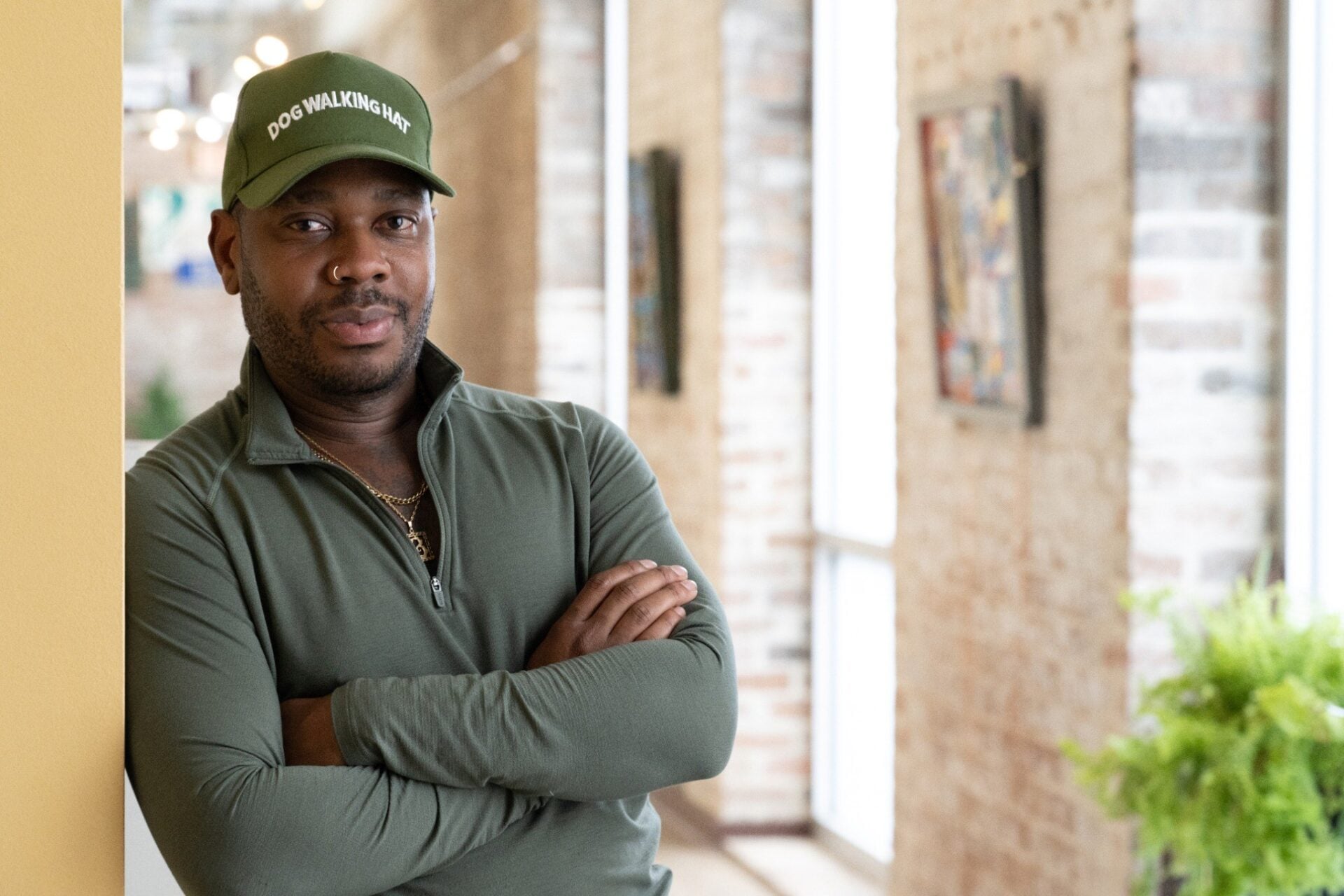


The oldest of three boys, Frank Dixon calls the Superdome his third brother given how important it was to his father: Dave Dixon, the indefatigable salesman widely credited as the heart and soul of the effort to build the legendary indoor stadium which opened half a century ago on Aug. 3, 1975.
It was a yearslong process full of politics and big personalities that required a lot of patience.
Frank Dixon recently sat down with Preservation in Print to share his unique perspective — dating back to the beginning — on a building that has witnessed some of New Orleans’ most riveting triumphs and worst heartbreaks.
PIP: Prospects of building what became the Superdome — best known as the home of the NFL’s Saints — received a major boost when your legendary sports promoter of a father helped organize exhibitions involving the Detroit Lions, Dallas Cowboys, Chicago Bears and Baltimore Colts in September 1963 at the old Tulane Stadium. But one of the city’s countless rainstorms also evidently had a role in getting New Orleans the Saints and a home for them. Tell us about it.
FD: It started raining in the fourth quarter (of one of the games) like a deluge, and they had to stop the game and squeegee off the field and it took a while. (Then-NFL commissioner) Pete Rozelle was there, comes up to Dad and says, “You know, this is a real shame, you know?”
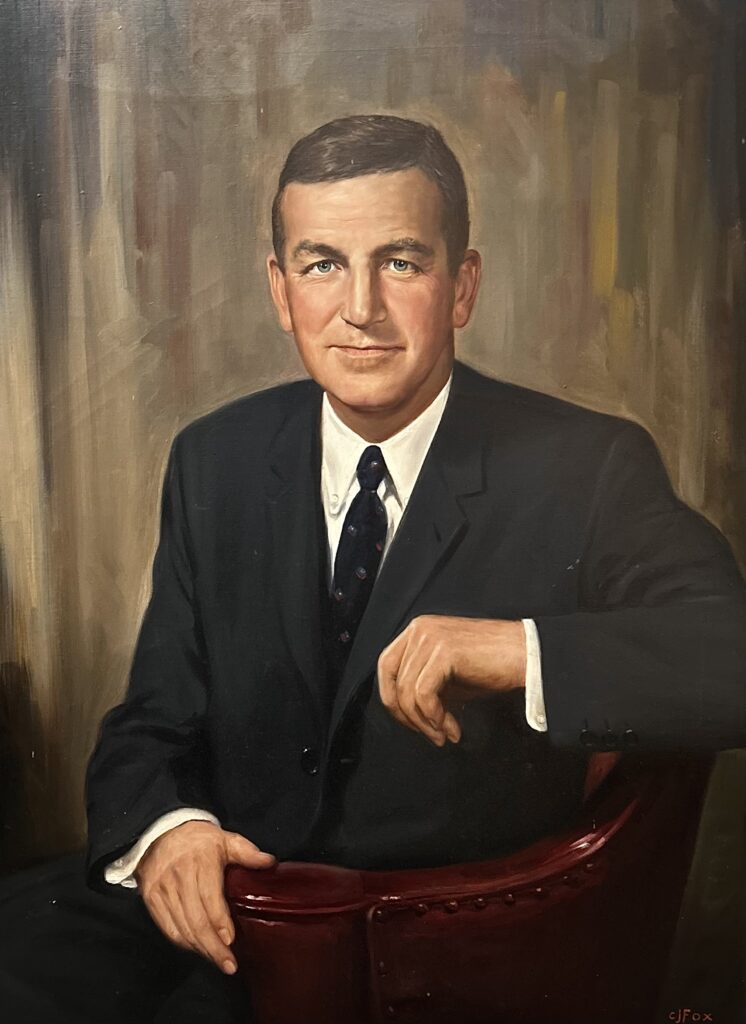
But just a few months before, Dad had gone over to Houston to meet Roy Hofheinz (owner of the Astros and a key player in the Astrodome’s construction). And Dad thinks of that and says, “Look, Pete, I’ve been meaning to tell you this — we’re going to build a domed stadium here in New Orleans.” And there’d not been a plan, at least not a very developed one. And Rozelle said, “Oh, really?” And so from that point forward, Rozelle somewhat considered New Orleans seriously.”
PIP: Your father, the chairman of New Orleans’ municipal sports commission, then brought the domed stadium idea to Louisiana’s governor, John McKeithen (in office from 1964 to 1972), with support from New Orleans’ mayor at the time, Victor Schiro. And in November 1966, voters essentially approved amending the state constitution to allow the Superdome to be built and the NFL awarded the Saints to the city. You were there when crews broke ground on the dome five years later. What stands out about that day?
FD: I was studying at LSU, and school was out. There was a second-line from City Hall to the stadium site, and they had the pile driver set up to start the construction of the dome. There’s about maybe 200 people there, or something like that, and the governor steps out ahead of the crowd about eight or 10 feet. And I honestly don’t know what got into me — I decided to go stand up next to him, and I said, “Governor, do you mind if I join you?” He says, “No, Frank, that’d be great.”
And so we stood there and watched them start driving the pile in — bam, bam, bam, bam and they probably hit it about 50 or 60 times. And this huge cable on the pile driver snapped! And I don’t know exactly how close that cable came to hitting the governor, but it came swishing by us really close — within 10 or 12 feet. And the governor looked at me and said, “Frank, we need to move back.” I said, “Yes, governor, we need to move back!” We would have been dead. That ended the ceremonies.
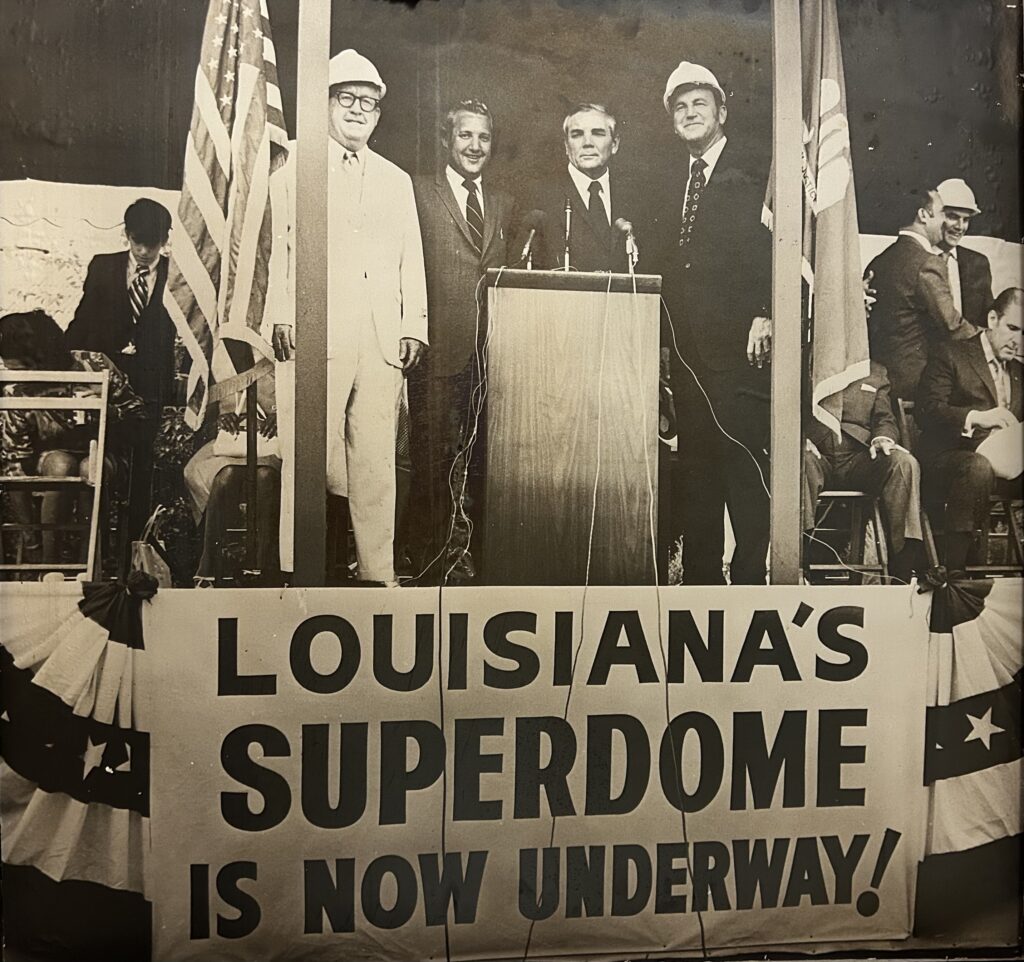


Jefferson Parish President Tom Donelon, Mayor Moon Landrieu, Gov. John McKeithen and Dave Dixon at the Superdome’s groundbreaking on Aug. 11, 1971. (Courtesy Frank Dixon)
Work begins on the Superdome (WVUE-TV film)
The Superdome site after work began. (Courtesy City Archives & Special Collections, New Orleans Public Library)
Dave Dixon and Gov. John McKeithen discuss the Superdome during a meeting.
PIP: The rest is history. Opening in 1975, the roughly 73,000-seat Superdome has hosted a record eight NFL Super Bowls; multiple college football and basketball championships; Muhammad Ali reclaimed the world heavyweight title there; everyone from the Rolling Stones and Taylor Swift has had concerts there. Not to mention the graduations. What’s your favorite moment in that building?
FD: When we (the Saints) won that playoff game that led us to the Super Bowl in 2010. Most people don’t remember this, but my dad died at 87, six months after we won the Super Bowl. Thank God he got to see that.
PIP: With them winning only eight playoff games at the Superdome so far, there’s unfortunately a lot of these to choose from. But what was the most painful Saints-related moment you’ve seen there?
FD: There were so many. So many. But the “no call” was horrendous (when the Saints lost out on a 2019 Super Bowl berth after referees refused to call an obvious pass interference that almost certainly would have let them take a one-touchdown lead while leaving almost no time for the Los Angeles Rams to respond).
PIP: The roadway between what is now the Caesars Superdome and the Smoothie King Center is named Dave Dixon Drive. And for years, a banner boasting your father’s name hung in the dome alongside ones honoring Saints legends Archie Manning, Rickey Jackson as well as Jazz star Pistol Pete Maravich. Seeing those reminders of your dad – what was that like?
FD: It was like my heart, you know? He went out and performed an impossible dream, almost. Even though he had guys helping him, he stuck his neck out to do this. And not many people do that kind of thing. I refer to the Superdome as my baby brother. I do. I’m not kidding. That was my dad’s fourth child.
RAMON ANTONIO VARGAS is an editor and reporter for The Guardian. He was previously a reporter for The Times-Picayune and The New Orleans Advocate, where he covered the Saints.