
Join us for a beautiful evening inside this spectacular Garden District home as we toast to the season at the Holiday Home Tour Patron Party on Dec. 6.
Click here for tickets and tour details.
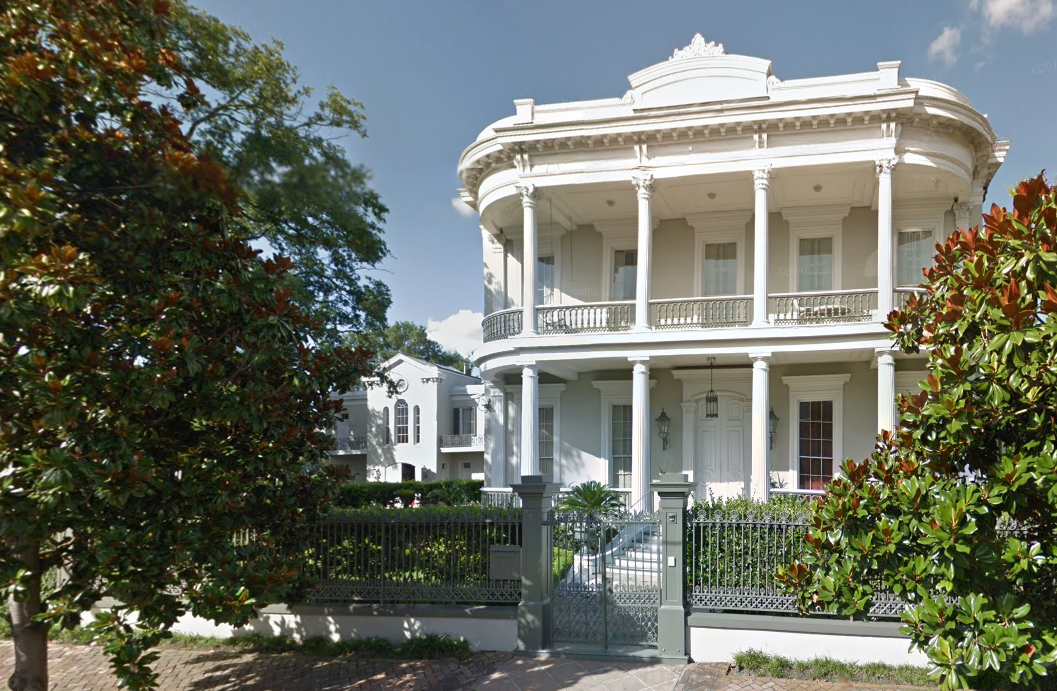
The Italianate Villa on Third Street will host this year’s Holiday Home Tour Patron Party. It survived the Civil War, sheriff’s sales, years as a boarding house and multiple storms — until Hurricane Ida hit New Orleans on Aug. 29, 2021.
When the Lauscha Family returned to their Garden District home after evacuating, the scene was devastating: slate tiles were blown off the roof and water had poured into the attic. Even though the old attic gutter system helped move water out, the amount of water that came down and how quickly it fell was so overwhelming it made its way into “every single wall of the house,” they said.
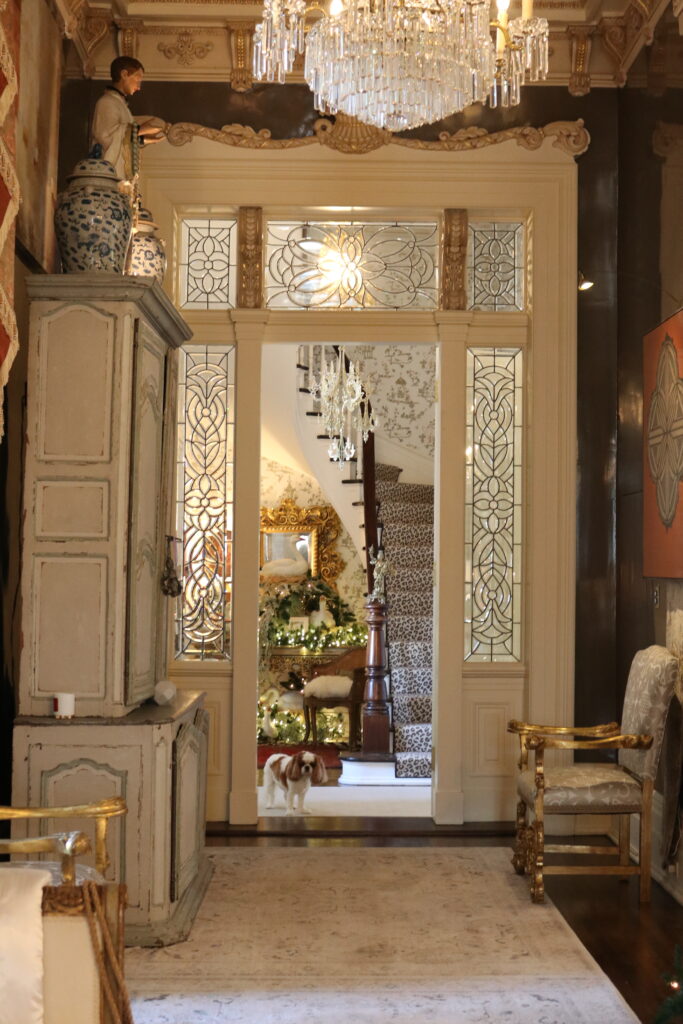
Except for one room, the plaster walls on the first floor and second floor had to be opened up and dried out. Damaged hardwood floorboards in the dining room and hallways were replaced with salvaged planks from the double parlors. A Versailles pattern hardwood was installed in the double parlors.
Every piece of furniture had to be moved into storage during renovations, and the Lauschas had to start all over again making this architectural gem shine.
The Lauschas purchased the house in 2017. They immediately embarked on giving it a personal touch and slowly began updating the house.
No sooner than the kitchen was updated and nine air conditioning units were replaced, six were crushed beyond repair during the storm.
It would be two years before the family was able to move back in. They have restored this New Orleans architectural treasure and have decidedly improved upon it by reflecting on the daily use of a modern day family. Michael Carbine was the general contractor and architectural designer. “We want to leave the house better than we found it for future generations,” they said.
The house was originally built for Walter G. Robinson, who came to New Orleans from Lynchburg, Va. Robinson made his fortune as a banker, cotton trader and farming perique tobacco, grown only in St. James Parish.
He purchased the lot in 1857 and soon after, mortgaged the house in 1861 before leaving the city due to the Civil War. Upon returning in 1866, Robinson encountered financial problems, as well as mourned the loss of his wife, and sold it to his business partner, David C. McCan. The house was completed in 1867.
After McCan and his wife died in the early 1890s, it became a boarding house. In 1905, insurance company owner Peter Pescud bought the house at auction for $18,000. After Pescud and his wife, Margaret Maginnis (who was Queen of Carnival in 1874) died, Metropolitan Life Insurance Company bought it in 1935 for $500.
Cornelia and Thomas Jordan, a cotton trader, bought the house in 1941 for approximately $32,000 with a restoration overseen by architect Douglas Freret. It was owned by the Jordan family for close to 60 years before it was acquired in 2000 by Shirley and Frank Sinclair.
(Jordan’s daughter, Dolly Jordan, hosted a PRC Holiday Home Tour party in 1999 featuring Better Than Ezra as special guests.
The three-story house is noted for its five-bay, central hall plan highlighted by the two-story galleries that curve as they meet the facade of the house. They are supported by fluted columns: Doric on the first floor, Corinthian on the second floor. On the right side, there are double galleries with cast-iron supports and arches, an ornamental frieze, denticulated cornice and anthemion crest. A swimming pool and fountains were added in the early 2000. A wrought-iron fence with anthemion ornamentation encloses the yard.
The first- and second-floor ceilings are nearly 16 feet tall.
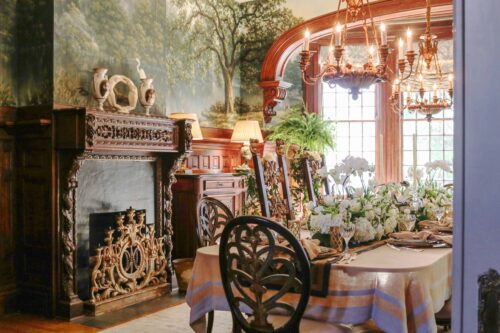
The 40-foot-by-20-foot dining room is in a semi-octagonal bay on the right side of the house. The painted ceiling is credited to Dominique Canova, who also did the ceilings of St. Alphonsus Church. Thomas Oppliger restored the frescos after Ida.
A two-story service wing extends out from the left rear of the house and is connected to the carriage house and service wing, which is believed to be original to the Livaudais Plantation and one of the oldest standing structures in the Garden District.
Henry Howard was the architect and his influences are seen in its similarities to Nottoway Plantation. The floor plan is one he had used in as early as 1858, in the Vredenburgh house. A center hall runs from front to back. To the right side, a superb staircase separates two rooms of equal size. An additional Howard touch is apparent in the service wing. It projects as a major architectural component to the left, a treatment Howard used at Belle Grove. The construction timeline is unknown. Several published works on the Garden District claim the house was completed in 1864. Howard could not have finished the work. He left the city in May 1863. A logical choice to complete the work would have fallen to another architect, James Gallier, Jr.
[Summarized From “Henry Howard: Louisiana’s Architect,” page 201-203]
Today, the Lauschas honor the past while ensuring the house’s future, breathing new life with lively gatherings into a beloved part of New Orleans history that has weathered more than a century of change.