


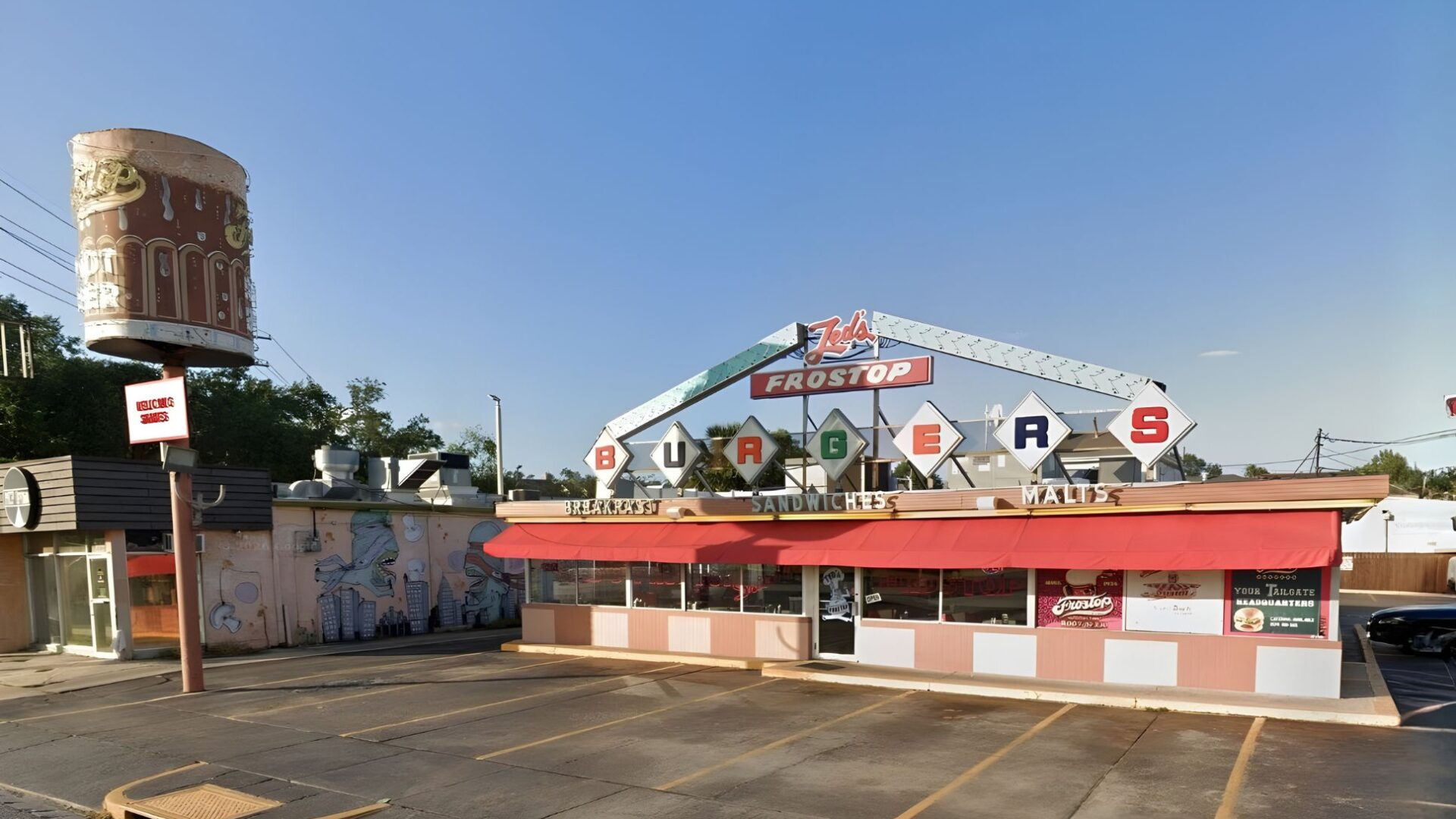
On Wednesday April 8, 2026, the New Orleans Historic District Landmarks Commission unanimously denied the demolition of Ted’s Frostop at 3100 Calhoun St. The meeting included almost two hours of public comment and deliberation. The applicant, who is the Robert family of Robert’s Fresh Market, has 10 calendar days to appeal the HDLC’s decision to the New Orleans City Council. We encourage people to write to Councilmember Aimee McCarron ([email protected]) to ask her to uphold the HDLC’s decision.
The commission received 162 pages of testimony against the demolition of Frostop, and two letters in support. A petition to save the building, organized by the neighborhood advocacy nonprofit Town of Carrollton Watch, was also submitted to the commission and by the time of the meeting included around 2,000 signatures.
More than two dozen concerned residents, neighbors, and advocates attended the public meeting and spoke in opposition to the demolition, expressing their appreciation for the diner and its classic midcentury modern architecture and signage, and lamented the lack of communication from the development team prior to the announcement of the proposal in the media in late March 2026.
The Preservation Resource Center also spoke against the demolition, noting an unfortunate pattern of dismissing midcentury modern architecture as unworthy. But the more midcentury buildings we lose, the more valuable these remaining buildings become.
Three people spoke in favor of the demolition, including a member of the Robert family and Zach Smith of Zach Smith Consulting & Design. These proponents noted frustration with the staff report produced by the Historic District Landmarks Commission, which rated the Frostop as “non-contributing” to the Carrollton Historic District. They argued that the additional analysis, which concluded the property did meet some of the criteria for landmark designation, was contradictory.
Frostop, which was built in 1955, falls outside of the Carrollton History District’s period of significance, which is between 1840-1937. A non-contributing rating, however, does not automatically allow an owner to demolish a building. Because demolitions are a drastic action, the commission still must consider each demolition application on an individual basis. Midcentury modern buildings frequently fall outside of the period of significance for historic districts, so it is critical that even non-contributing buildings are re-evaluated as part of the permitting process.
HDLC Principal Architectural Historian Yvette Jett’s additional research and analysis that was included with the staff’s report illustrates the ways that this building is worth saving. Architecturally distinctive for its roadside midcentury modern building and its playful and bold Googie-influenced signage, it is also culturally significant as a place that serves an active role in people’s current lives, as well as the community’s collective memory. The root beer mug, which was locally manufactured on Magazine Street, took on its own significance as a symbol of recovery when it was reinstalled in 2012 after toppling in Hurricane Katrina.
The public reaction to the proposed demolition of Frostop has shown an overwhelming amount of support for saving the iconic diner. That communal reaction is extraordinary today, and it should not be ignored.
The PRC recommends a thoughtful approach to designing new construction in historic districts that prioritizes retaining the city’s historic architecture. We encourage the applicant to think more creatively to find a solution that avoids demolishing this rare architectural icon. Attaching a classic sign to a generic new build would be a terrible loss for the neighborhood and city.
The same development team also applied to demolish two neighboring properties at 6307-6309 S Miro St. and 6309-6311 S Claiborne Ave. The HDLC staff had no objection to demolishing either building, but the commission decided to defer the applications to allow the developer time to consider updates to their plan in light of the Frostop denial.