


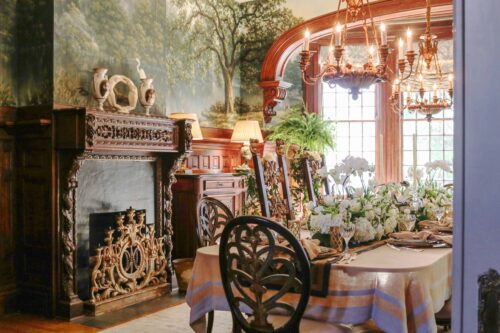


The grand home at 830 St. Philip St. stands three stories high and is ornamented with a cast iron double gallery. The imposing façade contrasts sharply with the service ell in the back, where Nanette Baham lived in the 1840s and 1850s.
Nanette moved to St. Philip Street when Dr. Charles Henry Daret bought the property in 1843 for his growing family. Daret had a son, Henry, and a newborn daughter, Marguerite, with his wife Celestine Duplantier. Nanette had watched over generations of the family’s daughters and would now do the same for Marguerite.
Nanette was born around 1783 on the banks of the Tchefuncte River in Madisonville. Her mother Thérèse was enslaved by Charles Parent. Her father was Jean Baptiste Baham.
Jean Baptiste Baham was awarded a land grant from the Spanish governor in what is now Madisonville. The Bahams and Parents were close neighbors.
When Parent died in 1804, Jean Baptiste Baham purchased Thérèse and his son Honoré from the estate and ultimately freed them. But Parent’s widow and heirs would not part with Nanette. She was the gardienne or nursemaid of their youngest child, Aimée. When Aimée grew older, Nanette became the property of her older sister Jeanne Celeste Parent and her husband, Dr. Louis Fortin. Nanette then cared for the Fortins’ children. Upon the marriage of the Fortins’ daughter Arsène to Armand Duplantier Jr., Nanette was again assigned the role of caregiver, this time for sisters Celestine and Louise Duplantier. Dr. Louis Fortin entered into a partnership with his son-in-law, and he and Duplantier purchased a plantation in St. James Parish. Nanette lived there at least part of the time.
In 1826, Armand Duplantier applied to the mayor’s office for a passport allowing him to take Nanette with him out of the country. Described as “a mulatresse named Nanette, age 45 years, height 5 feet 1 inch,” she accompanied Duplantier and his daughter Louise on board the ship Henry Astor bound for Havre, France. Louise suffered from curvature of the spine, and Duplantier was seeking medical treatment from physicians in Paris in the hopes of healing his daughter. Nanette was responsible for Louise during the long voyage before she was entrusted to a special hospital.
After Dr. Fortin’s death in 1828, Duplantier inherited several enslaved domestic servants from his estate,
including Nanette. It appears Nanette gained her freedom sometime between 1828 and 1840. According to the 1840 census, there was one free woman of color, between 36 and 54 years of age, living on Duplantier’s plantation; this was likely Nanette.
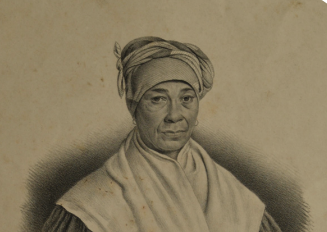
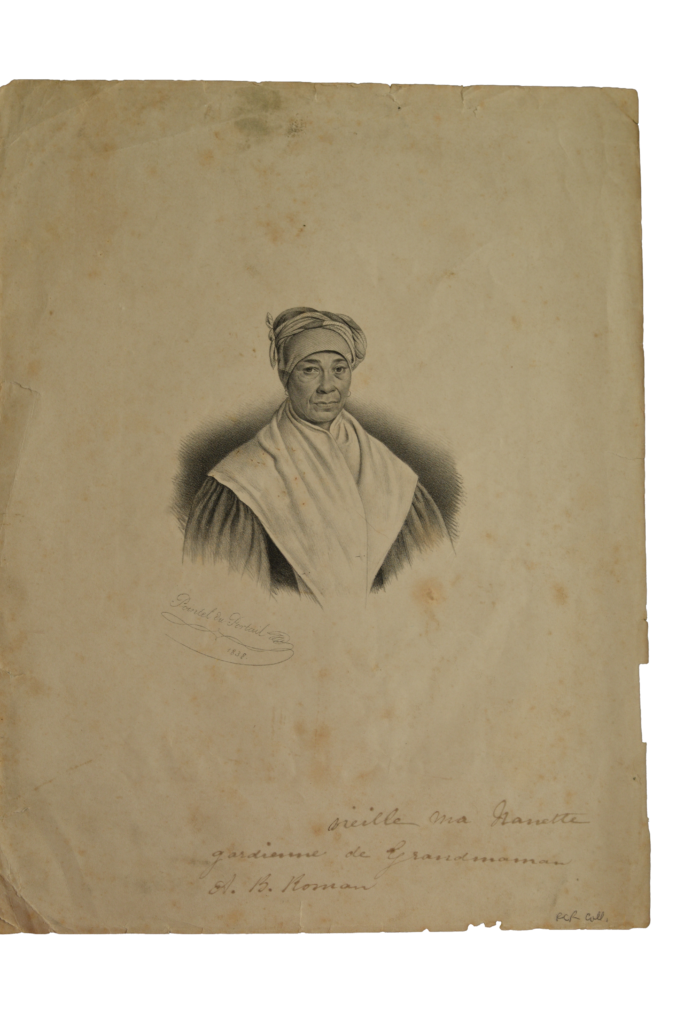
In 1838, Nanette’s portrait was made by J. B. Pointel. The lithograph of Nanette is now in the collection of Oak Alley Plantation Foundation. Writing on the bottom of the picture identified the sitter as “Old Nanette,” the guardienne of Aimée Parent Roman, wife of Gov. A.B. Roman.
In an 1804 letter, Celestine Duplantier’s grandfather Armand Duplantier Sr. offered his experience of the role of guardiennes in Creole families. Duplantier Sr. wrote that his daughter spoke of her “white mama and her black mama. . .who reared her” and that both these maternal figures “often anger[ed] her, by not letting her carry out all her little whims.” Although the Duplantiers may have spoken of Nanette and other guardiennes as members of the family, these women may have held a different perspective on their relationships with their white enslavers. While many experienced better living conditions and elevated statuses in households, guardiennes also lived in close proximity to their enslavers, causing them to be
constantly scrutinized and subject to abuse.
On Dec. 24, 1853, Nanette visited a notary to make her will. She established Celestine Duplantier Daret and Aimée Parent Roman as her beneficiaries. Nanette was also in possession of two notes, one from Charles Parent, brother of Aimée and the Widow Fortin, for $600, and the other of Victorin Maurin at the order of A. Roman for $656.65. As it was prohibited by law to educate the enslaved, Nanette had never learned to write and signed by mark. Three years later, the Widow Fortin remembered Nanette in her own
testament. She intended to free the enslaved women Polly and Sally upon her death and left Polly and Nanette her linge de corps, essentially undergarments.
Nanette Baham died on the morning of May 25, 1859, at a house situated on Dauphine Street between St. Ann and Dumaine. She was in her late seventies when she succumbed to chronic dysentery. Nanette’s funeral and burial were paid for by Dr. Daret. At six in the evening, Nanette’s mortal remains were transported to St. Louis Cemetery No. 2, where she was interred in an unmarked grave. Her face lives on, a rare image of extraordinary historical significance.