
As an archaeologist, I often get questions from the public about odd things that show up during construction or landscaping projects around the city. It’s natural, and it’s a part of my job that I love. In a place like New Orleans with such a rich history, the past is always very close at hand.
While I’ve been doing archaeology in New Orleans for more than a quarter-of-a-century, I never feel like I’ve seen it all. There are always surprises and new mysteries to solve. Still, it is rare for those routine questions to become truly international in scope and involve an interdisciplinary team of scholars, museum professionals and the FBI. But that is exactly what happened earlier this year.
A SURPRISING DISCOVERY
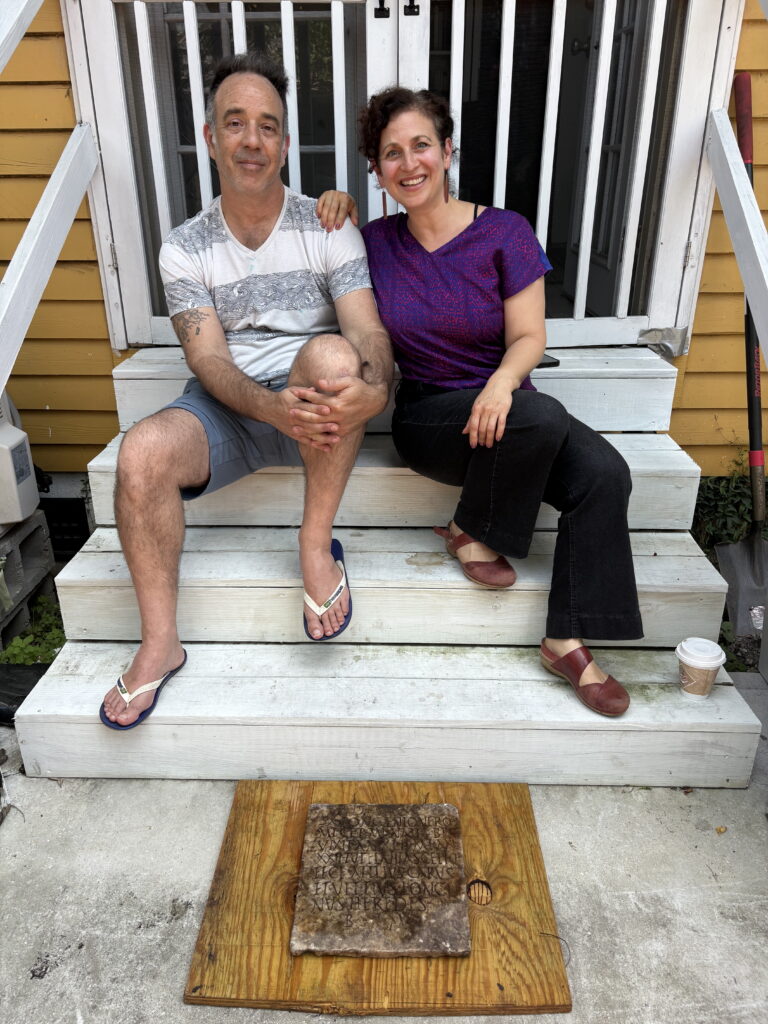
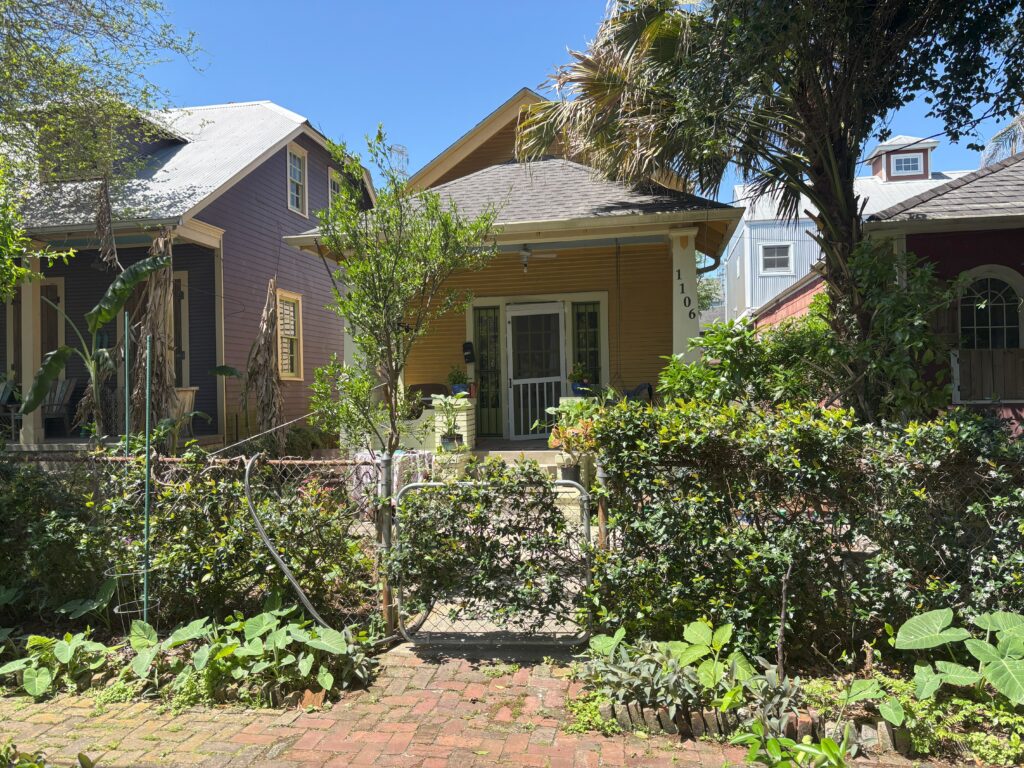
Daniella Santoro, an anthropologist at Tulane University, contacted me in March. She and her husband, Aaron Lorenz, the owners of a historic home at 1106 Cambronne St. in the Carrollton neighborhood, were clearing away some undergrowth in their yard when they ran across an unusual flat marble slab with a carved inscription that appeared to be in Latin.
Fearing that it might indicate that their house was located over a forgotten cemetery, Santoro reached out to us at UNO. It’s a reasonable enough question. There are a number of known cemeteries across the city that were later built over, and there are others still to be discovered, particularly the cemeteries of people who were enslaved on suburban plantations, many of which were eventually incorporated into the modern street grid.
We’ve worked to identify and map these cemeteries, so I could tell Santoro with a fair degree of certainty that this was unlikely to be the stone’s source. What was it then, and why was it there in her backyard?
Obviously, the inscription itself was a key piece of evidence, but it was clear that my high school-level Latin was not up to the task of deciphering it.
I sent photographs of the stone to my colleague from the University of Innsbruck, Univ.-Prof. Harald Stadler, who shared it with his brother, a Latin instructor. Meanwhile, Santoro shared photos of it with Dr. Susann S. Lusnia, Associate Professor of Classical Studies at Tulane.
They quickly came independently to the same conclusion: not only was this a Roman funerary inscription for a sailor named Sextus Congenius Verus, but the circa 2nd century inscription had been reported before. In fact, a stone fitting that exact description was missing from the city museum in Civitavecchia, Italy, near where it had originally been found!
This was a bit of a surprise, and it changed the scope of our inquiries. We agreed that getting the stone back to its rightful owner was a priority, but international repatriation of antiquities is a complex process. Thankfully, research and scholarship are truly a cooperative effort, and soon enough, Santoro assembled what she would eventually call her “Team Tombstone,” with Lusnia taking the lead on contacting the museum in Civitavecchia with this unlikely story.
After consulting with Tess Davis, executive director of the Antiquities Coalition, which specializes in the repatriation of stolen and looted items of cultural heritage, we concluded that the case needed to proceed through the FBI’s Art Crime Team. They helpfully agreed to pick up the stone and keep it in custody while the repatriation process began.
AN INTERNATIONAL MYSTERY
With a legal path to restore the stone to its rightful owners in Italy, we came back to the question of how it ended up in a back yard in Carrollton. It had clearly been brought to the location sometime in the 20th century, perhaps after World War II, and we hoped that archival records could shed some light on who collected this unusual (and illicit) souvenir.
For most of the 1900s, the Cambronne Street home had been the residence of the same family.
A man named Frank Simon purchased it soon after marrying his wife, Selma, in 1909. The 1940 U.S. Census gives a snapshot of the family: Frank Simon, by then 59, was the manager at the wholesale shoe company where he worked for most of his life, and he, his wife and his five adult daughters were resident at the address. All of his daughters were employed, four as salesladies in retail and one as a seamstress.
Simon died in 1945, and the house remained with his daughters until 1991. He and his daughters did not seem to be likely sources for the stone.
A next-door neighbor who served in the U.S. Navy during World War II initially seemed like a better candidate (or culprit). However, this too proved to be a dead end. Our colleagues Erica Lansberg and Rebecca Poole at The National World War II Museum were able to pull his service records, only to find that he was only ever deployed to the Pacific.
With these leads going nowhere, Lusnia was able to take the search to Italy, where she was headed for summer research already. She met with staff and curators at Civitavecchia’s city museum to learn more about the conditions there during World War II.
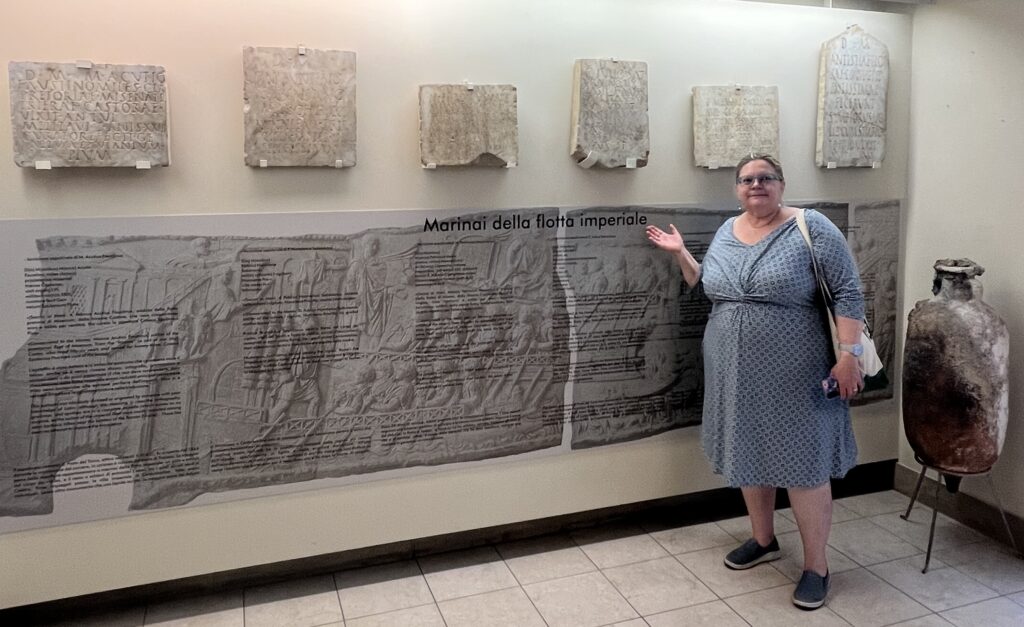
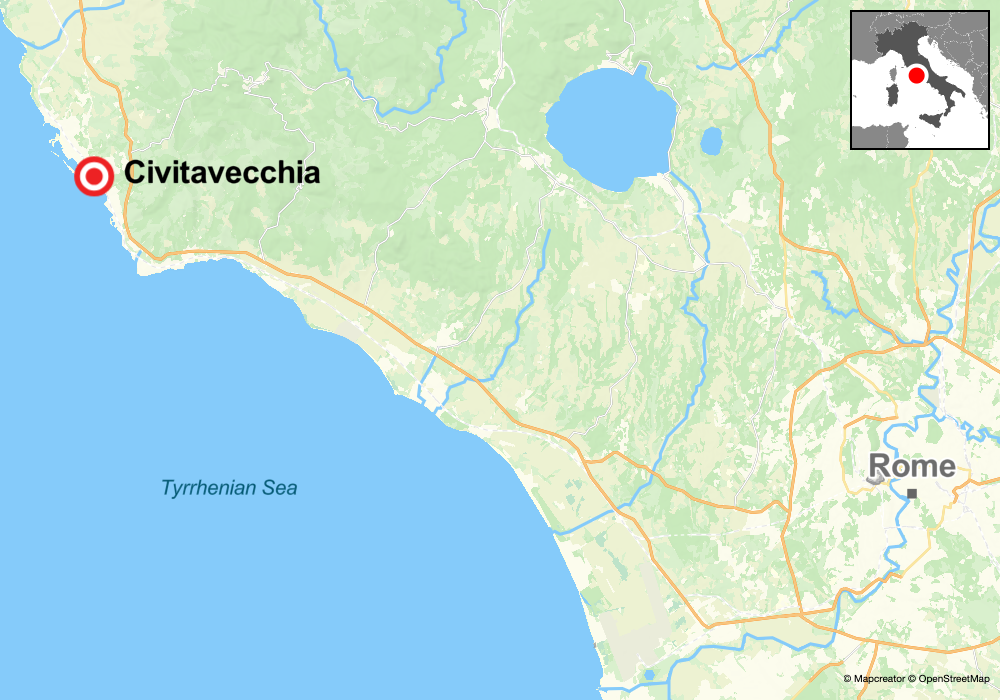
Civitavecchia, originally known as Centumcellae and located just northwest of Rome, served as a major port for the Roman empire and had maintained that function into the 20th century. As a result, the area was targeted in Allied bombing raids between 1943 and 1944, during which the museum was almost entirely destroyed and many of its collections lost. The museum did not re-open until 1970.
Lusnia also learned an important fact: a 1954 inventory mentioning the inscription was compiled based on earlier documents rather than firsthand knowledge. This made it all the more likely that the item was lost in the chaos after the war.
Through her committed research, Lusnia was able to confirm that the 34th division of the Fifth Army of the U.S. travelled up the western coast of Italy through Civitavecchia after liberating Rome, and various units remained there for some span of time. However, even if it were possible to pull the thousands of service records of soldiers who passed through the city in that era to look for ones with New Orleans connections, there is no guarantee that this would net results.
THE MYSTERY REMAINS
The stone could have passed into the hands of an antique dealer who sold it to a tourist in the years after the war when there was no real way to police the sale of antiquities. Perhaps a family member or someone cleaning out the house after a sale saw it just as a convenient paving stone for a muddy yard. Right now, it is impossible to say, though we’ll continue to look for new possibilities.
For me, this story reflects a wonderful intersection of a homeowner’s curiosity ultimately bringing to light something unexpected and historically significant. While we may never know exactly how Sextus Congenius Verus’ tombstone ended up in New Orleans, we do know that the item is now safe, and it is on the path to being returned to where it can be properly displayed.
The staff at Civitavecchia are excited to welcome it back, and they are hoping to throw a celebration when that happens. While there may not be many other 2,000-year-old Roman antiquities sitting around New Orleans backyards, there are many other mysteries and committed people who want to tell those stories.
Dr. D. Ryan Gray is the Richard Wallin Boebel Professor of Anthropology, the associate director of the Midlo Center for New Orleans Studies, and the director of the Honors Program at the University of New Orleans.