

Canal Street was a latecomer to the urban geography of New Orleans. Laid out in 1810 within the commons separating the French Quarter and the Faubourg Ste. Marie (today’s Central Business District), the capacious artery at first attracted residential land use, as a sort of grand avenue through the heart of the new American city. Not until the 1840s did retail emporia, previously aggregated along Chartres and Royal, start to gravitate to Canal Street. By that time, a number of opulent townhouses had been erected on Canal Street, particularly on its inland blocks, and among the most striking was a complex named Union Terrace.
Union Terrace was a mark of Anglo influence in a French Creole city amid great demographic change. Since the 1810s, incoming anglophone emigrants had increasingly rivaled francophone populations in all realms of life — economic, political, and cultural, including language, religion, and architect. An 1836 state law attempted to resolve the enmity by trifurcating New Orleans into self-managing “municipalities,” separating the more-Creole lower neighborhoods from the more-Anglo upper precincts.
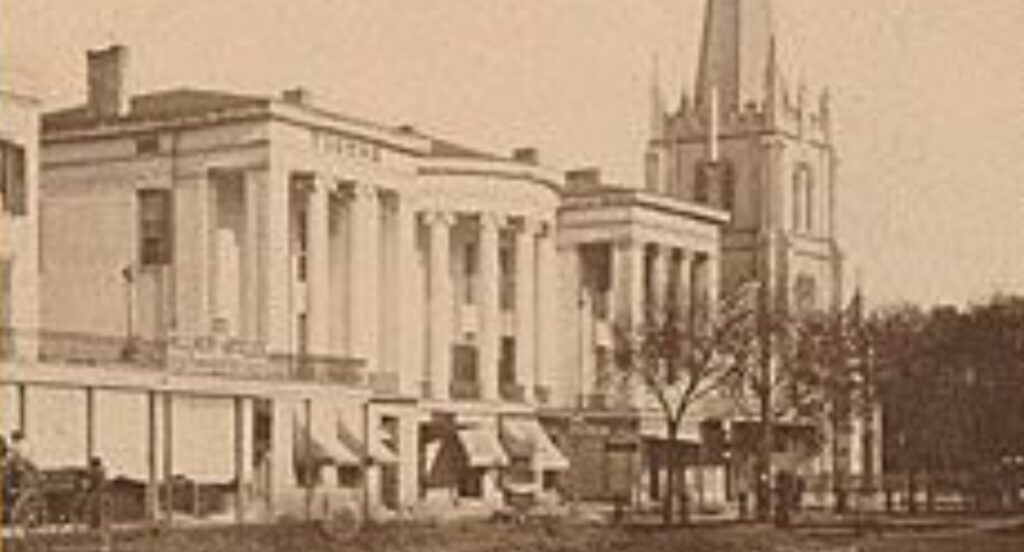
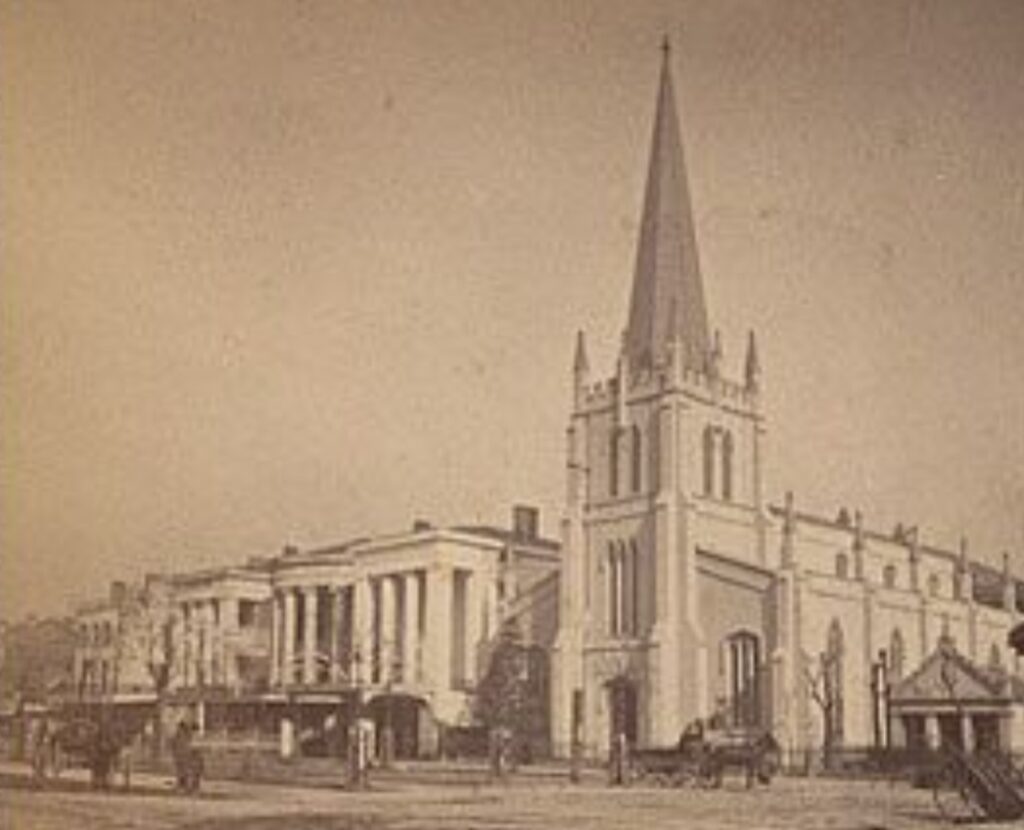
The Canal Street parcels acquired for Union Terrace happened to be in the Creole-dominant First Municipality, but that did not stop an Englishborn businessman from hiring two Anglo-American architects to create a Classical compound inspired by a project in New York City. The businessman was Richard Owen Pritchard, and the architects were the brothers James and Charles of the famed Dakin and Dakin partnership.
Pritchard was an unusual figure in New Orleans. Born in Shrewsbury-Devonshire in 1794, he fought in the Battle of New Orleans — for the British — and in 1818 became a U.S. citizen in the very city he had attacked only three years earlier. Here Pritchard earned a fortune in wholesale groceries, which he parlayed into banking, insurance, and the hotel trade. Pritchard was a key investor in the famed St. Charles Hotel, designed by James Gallier Sr. and James Dakin and opened in 1837 on the second block of St. Charles Street (now avenue) in the Anglo-dominant Faubourg Ste. Marie. Following a dispute with his partners, Pritchard built a competing hotel on the first block of St. Charles, the Verandah, which was designed by James Dakin after Dakin had a fallingout with his partner, James Gallier Sr., and teamed instead with his brother Charles Dakin.
It was during the Verandah project that Pritchard and his co-investors developed a liking for the work of Dakin and Dakin. The elder James Dakin had already earned an enviable reputation for Classical architecture in New York, the largest city in the nation, and he and his brother were among the emissaries of that idiom in the largest city in the South.
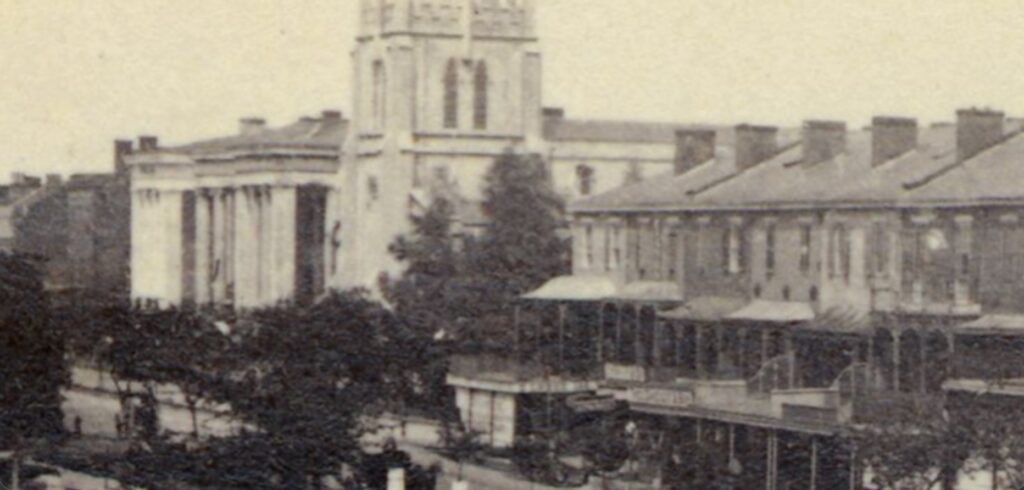
Already adept at the hotel trade, Pritchard wanted to diversify his portfolio with residential opportunities. Working with the Dakin brothers, he envisioned four spacious common-wall townhouses unified by a triptych second-floor colonnade, to be called Union Terrace. It would occupy the middle of what is today the 900 block of Canal Street, between Dauphine and Burgundy, a “power space” of this era, in that it was convenient to the city’s amenities and resources, far from the riverside bustle, yet equally distant from the muddy backswamp. Directly across the street sat the State House, Louisiana’s capitol building at the time, and all around were important public and private buildings. It was a prestigious address, and it called for monumental architecture.
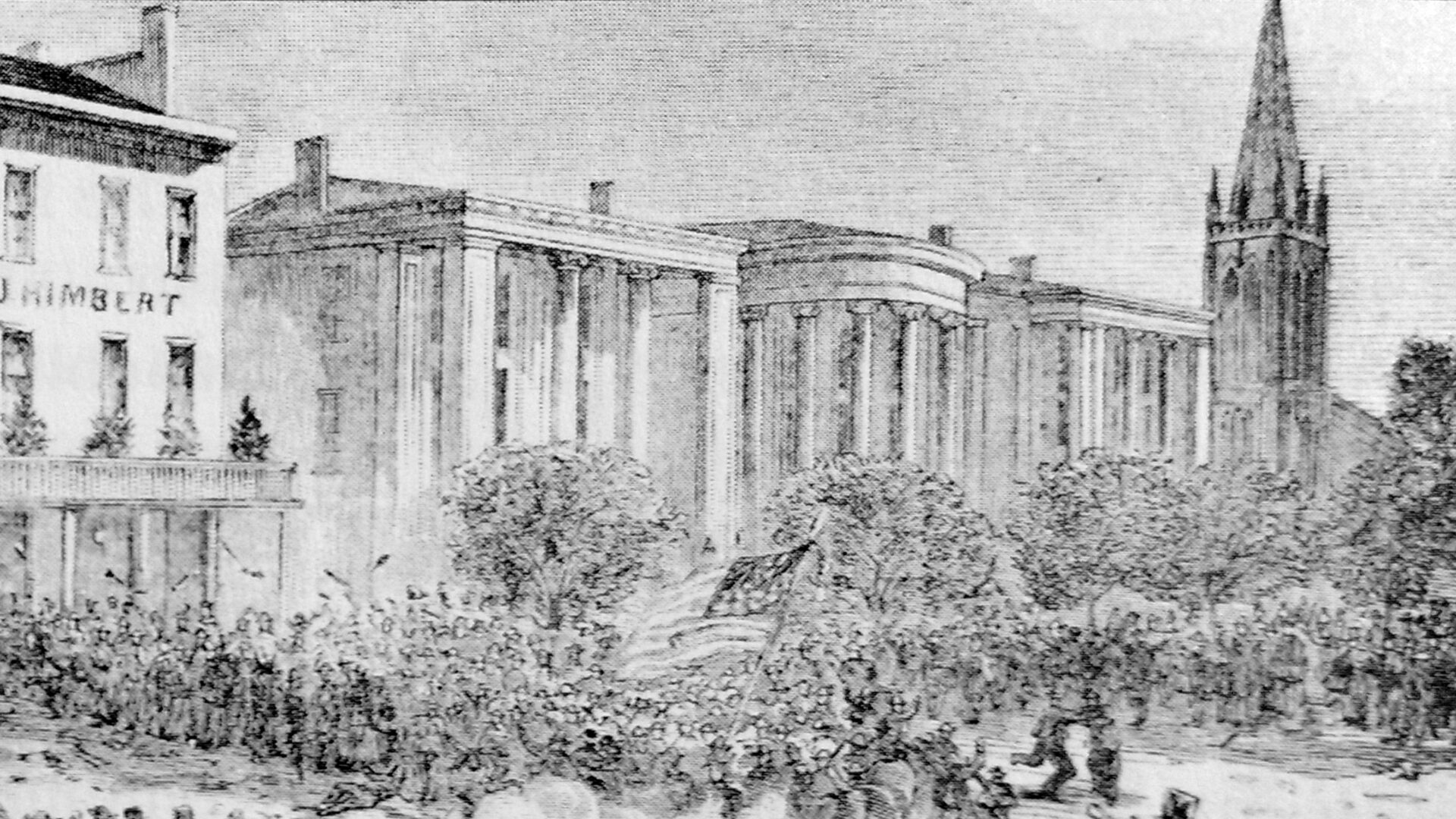
Union Terrace had, according to Dakin biographer Arthur Scully Jr., “a beautiful recessed, curved central bay” with columns and capitals of the Ionic order, flanked by two pavilions with flat entablatures and inset porticos. In the rear were four separate courtyards and dependencies virtually indistinguishable from other city townhouses, despite the singular façade. The complex reflected the influence of Manhattan’s Lafayette Terrace, with which James Dakin had some involvement through his previous partnership of Town, Davis, and Dakin, while the two wings had the Greek influence Dakin had recently designed for the Bank of Louisville.
The view from Canal Street gave the impression of three structural sections, which would later give rise to the nickname “The Three Sisters” (not to be confused with the Three Sisters of Rampart Street, designed and built at the same time by Dakin’s former partner and rival James Gallier Sr.). Others called the complex “Pritchard Row” or “Lafayette Terrace,” for its Manhattan muse. Inside were four separate residences to be occupied by Pritchard and his coinvestors. Union Terrace was built during 1836-1837 at a cost of $100,000 — “a tour de force for James Dakin,” wrote Scully, “and, being so prominently located on Canal Street, [it] must have gained him a great reputation for his skills.”
Unfortunately, Richard O. Pritchard barely got to enjoy his new home, having died unexpectedly in 1839. Families of his co-investors, including the powerful Bringier, Gasquet, and Field families, became Union Terrace’s early occupants. In 1847, they got a new neighbor, the Christ Episcopal Church, designed by James Gallier Sr. The house of worship, whose congregants included members of the Anglo elite, added to this area’s cultural and economic stature, and Canal between Dauphine and Burgundy became one of the most beautiful — and Classical — streetscapes in town.
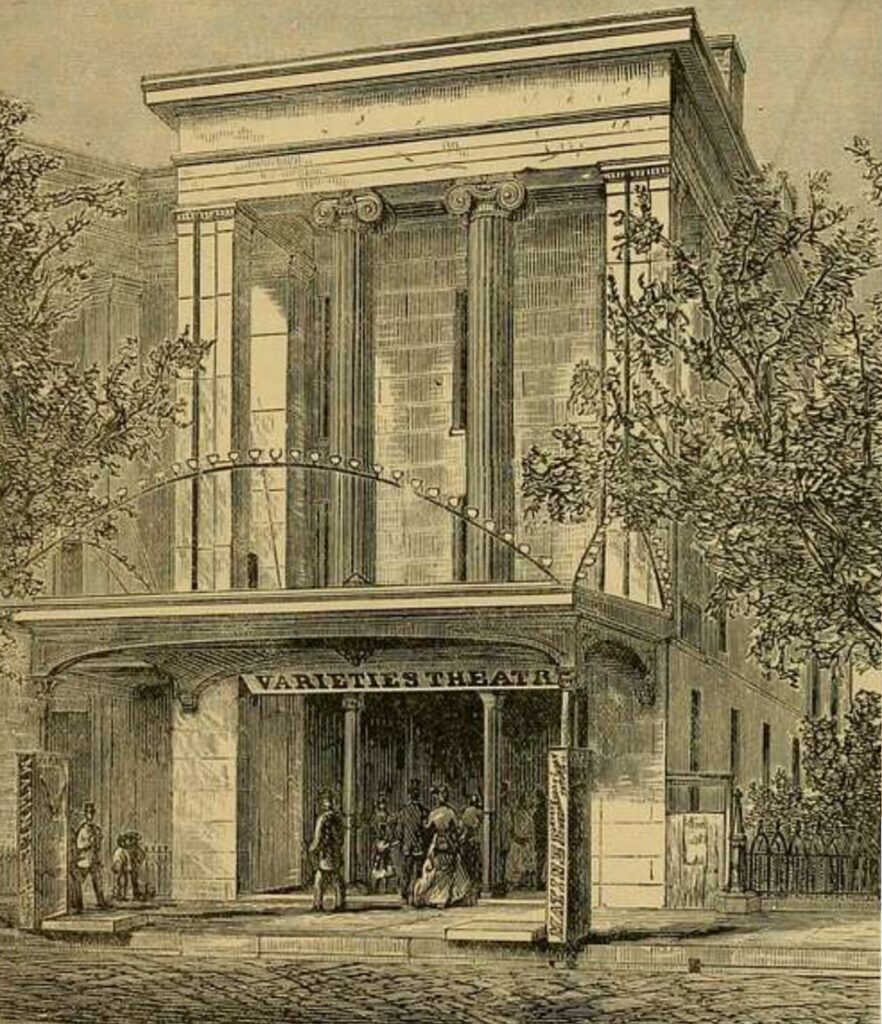
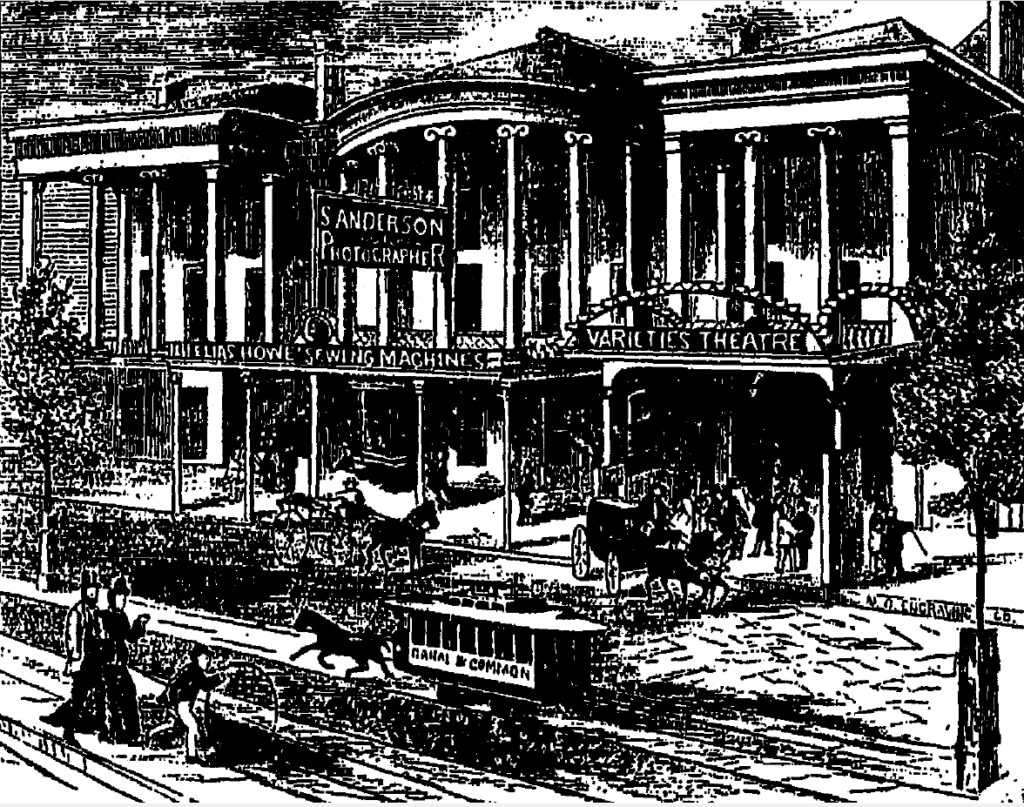
What was beginning to change, however, was economic geography. A new streetcar line on St. Charles Street opened access to what anglophones were now calling “Up-Town,” inspired by the vernacular of Manhattan. Affluent residential development increasingly gravitated in that upriver direction, to a certain precinct in the adjacent City of Lafayette. After New Orleans annexed Lafayette in 1852 — the same year the city abandoned the municipality system and reunified — people started to call that area “the garden district,” for its spacious lots and mansions amid lush horticulture. Meanwhile, the State Capitol had moved to Baton Rouge; the retailers on Chartres and Royal had expanded onto Canal Street; a gritty “back-of-town” neighborhood formed a few blocks to the rear; and Union Terrace soon found itself surrounded by bustling commerce and rambunctious nightlife. An 1872 article in The Daily Picayune captured the transformation, using Union Terrace’s nickname: “The ‘Three Sisters’ [were] originally constructed for Mr. Pritchard, in the year 1837, with the view of its appropriation for private residences, but when the great tide of business swelled in volume, to such an extent as to force its currents into Canal Street, [which] subsequently became the leading thoroughfare of the Crescent City, the building was remodeled for commercial purposes.” An accompanying engraving illustrated how Union Terrace had adapted to the times. Anderson’s photographic studio operated upstairs, while on the ground floor was the Howe Sewing Machine Company (“selling 600 machines per day”) and Victor’s Restaurant, started by the same Victor Bero who would later have a hand in opening Galatoire’s on Bourbon Street. Victor’s catered to the nightly theater crowd as they gathered in the Union Terrace unit on the right, closest to the river. A theatrical troupe known as the Varieties Club, having lost its original Gravier Street venue to a fire in 1870, had purchased that unit as well as the lots behind it, fronting Customhouse Street (now Iberville). There they built a great theater, “even uneclipsed by the far-famed Grand Opera House in New York,” and cleverly arranged for patrons to enter on Canal Street “through the entire sweep of one of the [Union Terrace] residences, the floor of the second story being removed to be substituted by a grand stairway” accessing the seating gallery on the Customhouse flank of the complex. By all accounts, it was a highly successful adaptive reuse of a building whose original programming no longer made sense, but whose architecture made it worth keeping. The Varieties Theater was a hit, and 180- 185 Canal Street, as it was enumerated at the time, prospered in a new way.
Three-quarters of Union Terrace came to a fiery end on Jan. 10, 1874, when “the work of an incendiary,” according to The Daily Picayune, caused $50,000 in damage and destroyed the businesses therein — though it spared the Varieties Theater, because it used its unit only as an entrance. (The Union Terrace complex appears undamaged in the 1876 Sanborn Fire Insurance Maps, indicative of the lag time between field research and finalization of those oft-referenced data sources. In fact, the damaged lots were cleared of debris by that time.)
Within a few years, three four-story storehouses were built on the ashes, this time with contemporary Italianate aesthetics rather than passé Greek motifs, and with the standard one-story cast-iron gallery typical of commercial buildings on Canal. The theater had expanded and renamed itself the Grand Opera House, while the Christ Episcopal Church, its congregation long since departed for uptown, was torn down in 1887 to make room for the Mercier Building. That ornate domed department store and office building became home to the original Maison Blanche.
The 900 block of Canal came into its present form during 1907-1910. The Grand Opera House closed in 1906, and a year later, the entire block was cleared, including the last of Pritchard’s Union Terrace units. At the Dauphine corner, work began on the enormous Beaux Arts building that would become home to the Maison Blanche Department Store starting in 1910. That same year, the Kress Building and Audubon Building opened on the footprint of Union Terrace over to the corner of Burgundy. All three buildings were devoted to retail and office space, completing the decades-long transition of 900 Canal Street from residential to commercial.
Today, all three buildings are over 110 years old, far older than any of their predecessors, and all three are now hotels — the very operation Richard O. Pritchard opted against in building Union Terrace. Pritchard is buried in Metairie Cemetery, and while no trace of Union Terrace remains, the memory of its unlikely English founder lives on in Pritchard Place, an Uptown street named in his honor.
Richard Campanella, a geographer and associate dean for research at the Tulane School of Architecture and Built Environment, is the author of Draining New Orleans, Bienville’s Dilemma, Bourbon Street: A History, and other books. Campanella may be reached through richcampanella.com, [email protected], or @nolacampanella on X.