


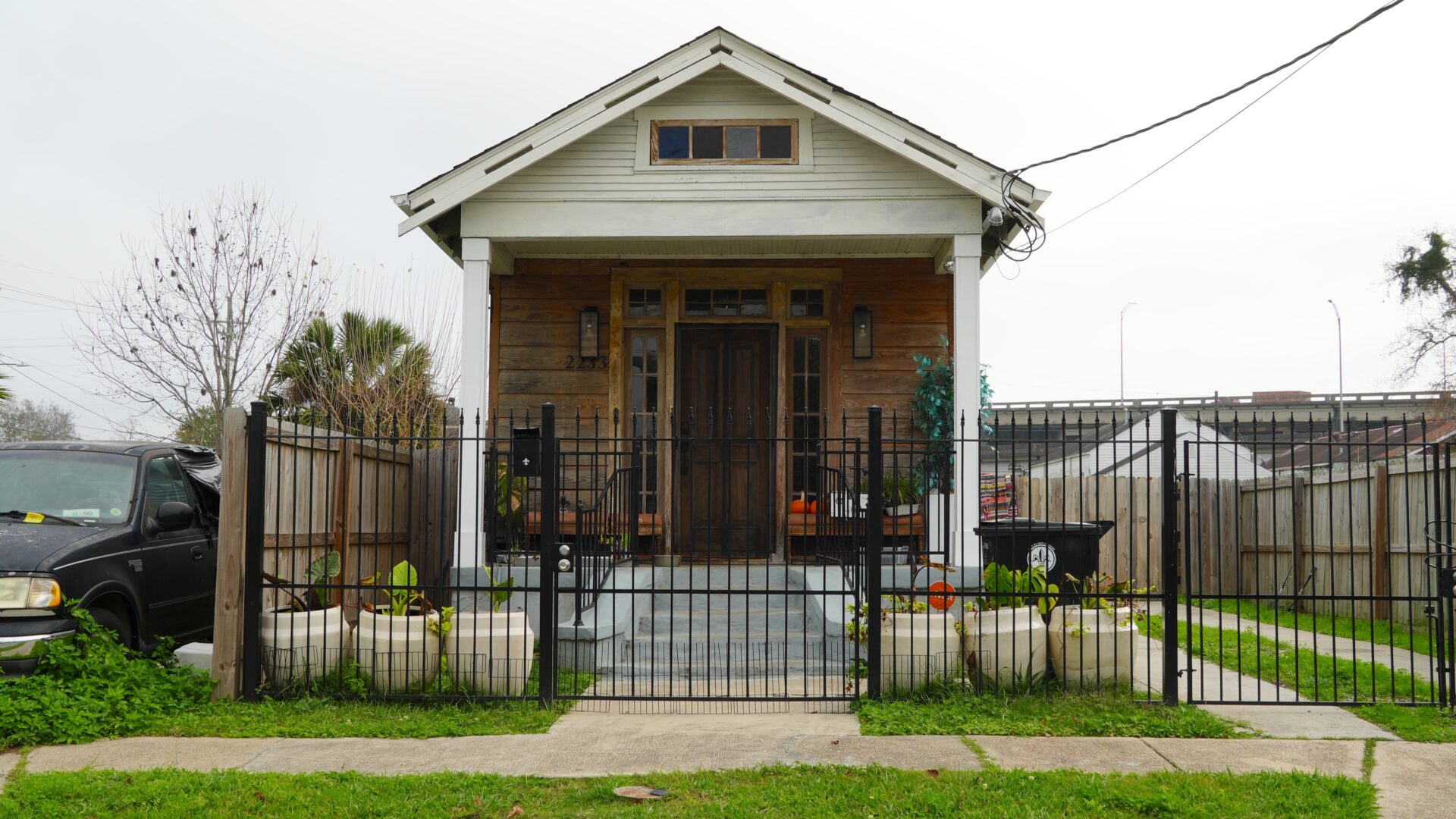
A quarter of a century after Armistice Day, the Toledano home on Touro Street lacked the peace for which the day had come to stand.
The Great War—the so-called war to end all wars—had proven to be a misnomer. As the Toledanos experienced their own personal grief and longing, a war raged across the globe.
Audrey Toledano Jourdain lay in her childhood home, giving birth to her first child. She was 20 years old when she welcomed her son into the world; she watched him leave it that same day. Audrey’s infant was laid to rest in the family plot in St. Louis Cemetery No. 3, where just one year prior, her father, Leon, had been interred. She called her son John Emile Jourdain Jr. after his father, who was serving in the military and preparing to be sent to England.
John Emile Jourdain Sr. was one of 73,000 Americans who landed on D-Day. He was a corporal in the 467th Anti-Aircraft Artillery Automatic Weapons Battalion. Jourdain and his fellow “ack- ack” gunners came ashore on Omaha Beach to shoot down any German aircraft that might target the beaches during the landing.
Although the Luftwaffe — the German air force — stayed away, Omaha was the site of the bloodiest conflict of the invasion, prompting Jourdain’s company to turn its gun on a German casemate. The German 50-millimeter anti-tank cannon was mowing down American GIs, and, despite suffering heavy casualties, Jourdain’s battalion succeeded in taking it out of commission. It took 23 rounds for some of the shells of their 37-millimeter gun to enter the slits of the thick, fortified concrete bunker.
The 467th AAA’s bravery garnered the attention of famous war correspondent Ernie Pyle.
In a July 1944 column featured in newspapers across the U.S., Pyle wrote that the ack-ack gunner’s actions were “akin to David slaying Goliath.” He noted that the gun used was named BLIP, an acronym representing the first letters of Brooklyn, Louisiana, Illinois, and Pennsylvania, the homes of the majority of its crew. He noted that Cpl. John Jourdain of 1466 N. Claiborne Ave. was one of the crew along with Austin Laurent of New Orleans. The story also appeared in Pyle’s book Brave Men.
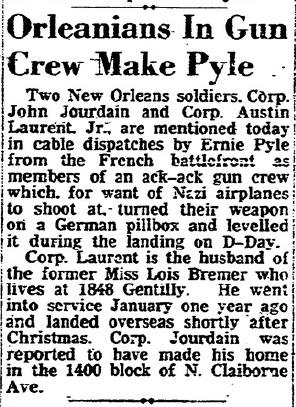
On July 1, 1944, The New Orleans Item ran a piece about New Orleanians being featured in Pyle’s dispatches. Details were provided for Cpl. Laurent, including his address, his wife’s name, when he went into the service and the approximate date he arrived overseas. All that was mentioned about Cpl. Jourdain was that he “was reported to have made his home in the 1400 block of N. Claiborne Ave.”
Race-conscious New Orleanians in the era of Jim Crow recognized something the draft board had not. The Jourdains were a prominent Creole family of free people of color prior to the Civil War.
During Reconstruction and its aftermath, several of the Jourdains fought for racial equality. That knowledge plus a 7th Ward address likely made readers raise their eyebrows. In fact, Jourdain was the son of John Jourdain and Olga Dupart, descendants of Creole free people of color, who had spent time living and working in Chicago while leaving Jourdain and his sisters to be raised by his grandmother.
Though Jourdain was likely of more European ancestry than African after the passage of so many generations, under Louisiana’s “one drop rule,” which classified anyone with 1/32nd or more African ancestry as Black, Jourdain would have been subjected to segregation.
In identifying as white when he was drafted in December 1942, Jourdain defied the racial hierarchy present in his hometown as well as the U.S. Army. During World War II, the military was strictly segregated. Black soldiers were forced to serve in separate units, use separate facilities, and take on limited roles. They usually held non-combat positions involving laborious work or transportation assignments. Most officials and military leaders did not believe that Black men would prove capable for combat; they certainly did not envision them helping to take out German pillboxes while under heavy fire, helping to turn the tide at bloody Omaha. Jourdain proved them wrong, but he had to do so by keeping his background clouded in secrecy.
Jourdain had fallen in love with Audrey Toledano, a stenographer from the 7th Ward whose background mirrored his own.
Audrey’s parents were Creoles of mixed racial ancestry. Her father, Leon Toledano, had worked for decades as a sail and awning maker before purchasing the house at 2233 Touro St. around 1923. His home was modest, but his lineage had deep roots. His grandfather, Lille François Sarpy, had been a white plantation owner in St. Charles Parish. Sarpy lived with his Afro-Creole family after the Civil War and married his children’s mother shortly before his death. Lille François Sarpy’s mother, Félicité Pauline Fortier, was the aunt of Alcée Fortier, the folklorist and historian who erroneously declared that Louisiana Creoles were of solely European heritage.
It remains unknown how many U.S. citizens previously classified as Black in census records and other official documents chose to identify as white and serve in combat roles during World War II. However it is certain that the racial and cultural shift was a permanent one for John Jourdain. After surviving the war, he returned home to Audrey. The Jourdains moved to Pennsylvania, where they had three more children.
John Jourdain died in Philadelphia in 1991. Audrey lived almost another decade, dying in Irving, Texas, on June 29, 2000. The Touro Street property remained in the Toledano family until 2019. Jourdain’s home on North Claiborne Avenue no longer stands.
Today a plaque marks the casemate neutralized by Jourdain and his comrades. Dedicated by surviving members of the battalion, it describes the action taken by its members on D-Day. At the bottom of the plaque are the words “Pax Vobiscum.” Latin for “peace be with you” and a part of the Catholic Mass, the Jourdains, raised in the Creole culture of New Orleans, would have known the saying well.
Katy Morlas Shannon is a freelance journalist and historian.