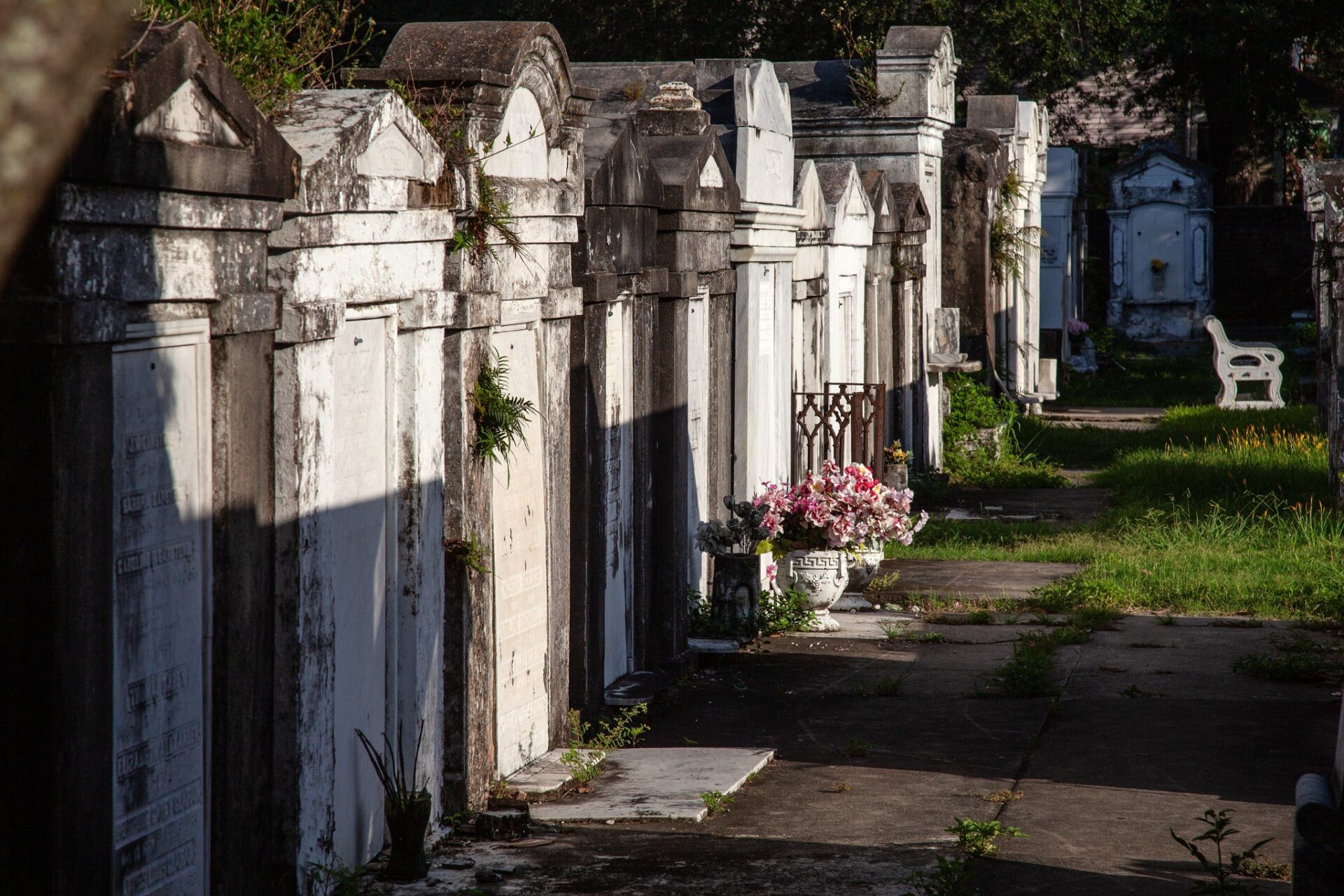
New Orleans’ historic cemeteries have been described as a “tangible record of a continuously developing cultural history.” Far more than resting places for the dead, they are extraordinary archives of the city’s cultural, social, ethnic, linguistic and religious history. They inform us about public health, life expectancy, traditions of mutual aid, popular piety, changing artistic tastes and religious devotions.
Most importantly for the genealogist, New Orleans’ tradition of multigenerational family tombs can preserve relationships across decades and even centuries, transforming a single burial place into a genealogical record in stone. Unlike individual graves, whose occupants may or may not be related to those buried nearby, New Orleans’ tombs, vaults, and copings were often reused by the same clusters of families and associates for generations, sometimes spanning a century or more.
The inscriptions found on these tombs can provide names, birth and death dates, maiden names, relationships, religious affiliations, military service, and other clues that may be absent from surviving civil or church records. Just as importantly, the grouping of individuals within a single tomb can reveal previously unknown kinship networks, prompting researchers to investigate relationships that might otherwise be overlooked.
Burial sites in Square 3 of St. Louis Cemetery No. 2 helped link Pope Leo XIV to two of his enslaved Black Catholic ancestors.
St. Louis Cemetery No. 2, which occupies three square blocks along North Claiborne Avenue from St. Louis to Iberville streets, was the city’s fourth cemetery when consecrated in 1823. The ownership of tombs and vaults in its third square, located between Bienville and Iberville streets, was almost entirely given over to people of color. In a guide published in 1980, historians Raphael Cassimere, Joseph Logsdon, and others asserted that Square 3 “probably contains the largest number of monuments in one place to note the achievements and struggles of Black Americans in the nineteenth century.”
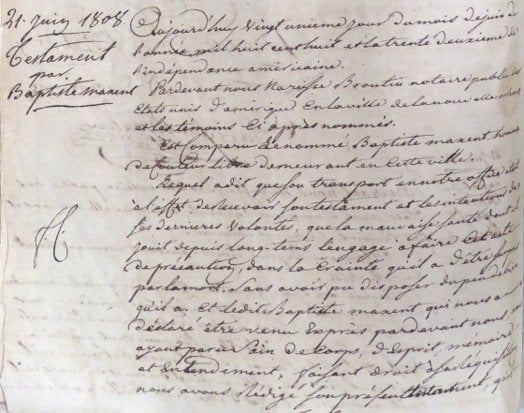
Baptiste Maxent’s 1808 Will. Born enslaved, he later purchased his freedom through coartación.
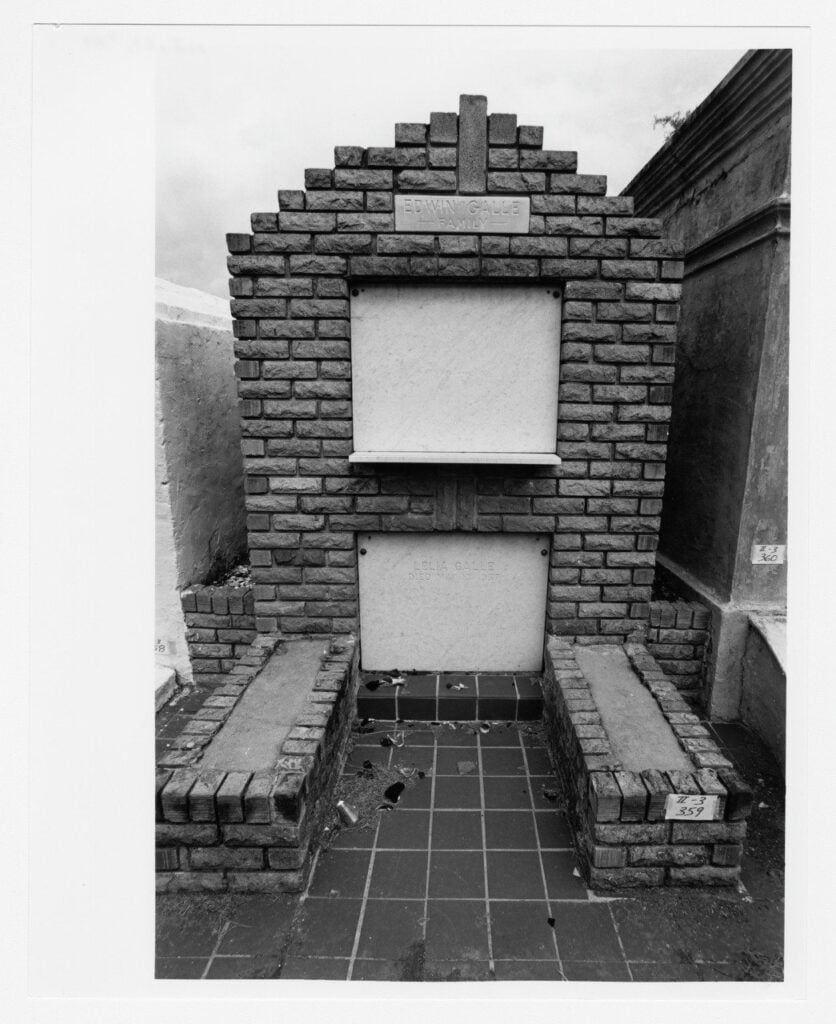
The Fletcher family tomb, later rebuilt for the Edwin Galle family, bears little resemblance to the structure in which Odile Copelle was buried.
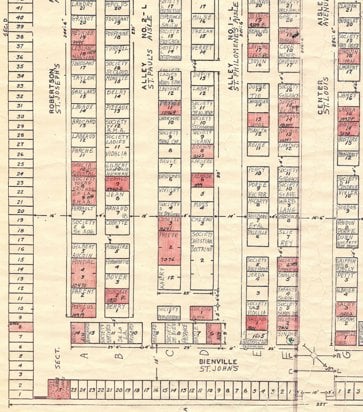
Square 3 plan showing Robertson aisle and Tomb 19, where Odile Coppelle was injured in 1873. Copyright archdiocese of New Orleans; used with permission.
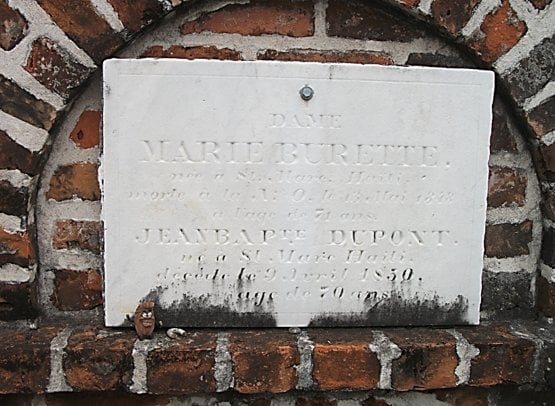
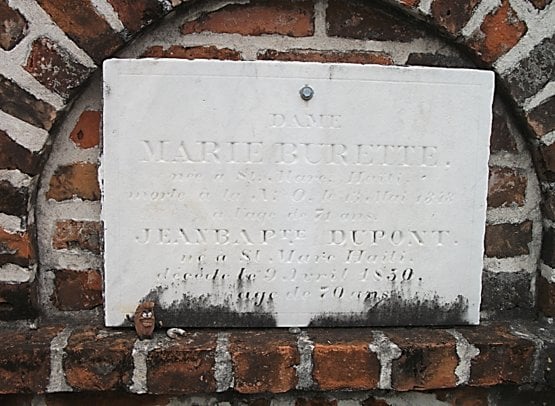
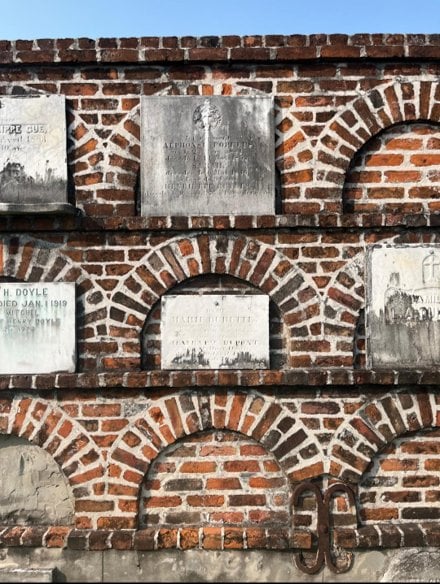
Five generations of the Martinez family, beginning with Dame Marie Burette, were buried in this Bienville Street wall vault.
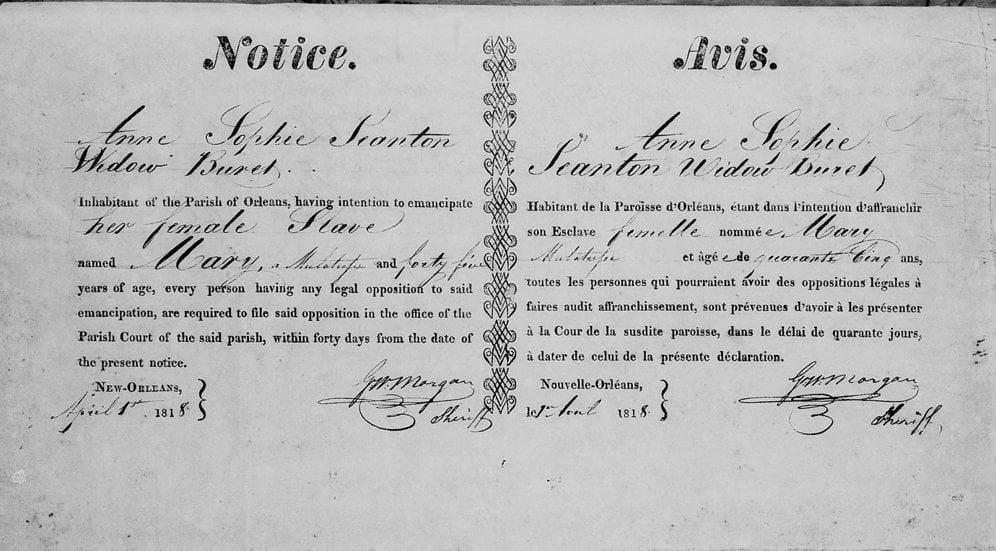
Bilingual notice dated April 1, 1818, announcing the intended emancipation of Marie, then about 45.
Tracing Pope Leo XIV’s Family Through Cemetery Records
Between April 1910 and November 1911, Joseph-Nerval Martinez and Louise Baquié, the maternal grandparents of Pope Leo, joined what has been dubbed the First Great Migration, the movement of almost 2 million Black people from the South to northern, midwestern, and western cities from approximately 1910 through the 1930s. For the Martinezes, the move from New Orleans to Chicago included a distancing from nearly 200 years of history in the Crescent City and a conscious choice to put any identification as people of color behind them.
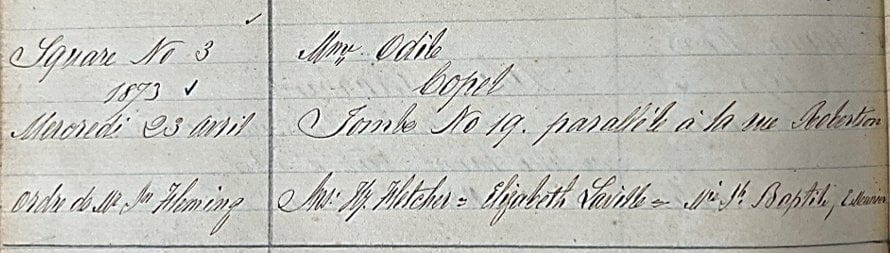
The so-called “Ownership” or “Sexton’s Registers” for St. Louis Cemetery No. 2 reveal that Joseph-Nerval’s only sibling to remain in New Orleans (his brother Michel), his father, mother, paternal grandmother, and three of his children who died in infancy are all buried in an unassuming wall vault along Bienville Street, about 40 feet to the left of the entrance to Square 3.
The closure tablet for the vault bears the name “Dame Marie Burette,” who was born at St. Marc in Haiti (then the French colony of Saint-Domingue) in approximately 1771 and who died in New Orleans on May 13, 1848. Further research revealed that Marie was Joseph-Nerval’s paternal great-grandmother, making her the first of five generations of her family to be buried in that wall vault.
An act of manumission recorded in the New Orleans Notarial Archives revealed that nearly 30 years to the week before Marie died, she was freed from slavery by Anne-Sophie Genton Buret Cadenet, the widow of sugar planters from Saint-Domingue who arrived in New Orleans with Marie in 1809. This third-great-grandmother of Pope Leo was one of the more than 10,000 free and enslaved refugees from the revolution in Saint-Domingue who arrived in New Orleans between 1809 and 1810.
The pope’s maternal grandmother was Louise Baquié, born in New Orleans in 1868. Thirty years before, her mother, Eugénie Grambois, was born here to a French pharmacist, Eugène Grambois, and a free woman of color named Odile Copelle. Odile’s origins proved difficult to trace. The end of her life, however, was more certain. She died on April 22, 1873, and was interred in a tomb belonging to Mrs. Henry Fletcher on the Robertson Street aisle of Square 3.
The Sexton’s Register for Square 3 showed that the other burials in that tomb were members of the family of Henry Fletcher, a free man of color who was buried there in 1853. Fletcher’s succession, opened in February 1854 by his collateral relatives, including Odile Copelle, put the pieces of the puzzle together. Odile and Henry were first cousins once removed. Her grandmother, Modeste Baptiste Maxent, and his mother, Marie-Joseph Baptiste Maxent, were sisters.
Their father, Baptiste Maxent, purchased his freedom from the family of wealthy merchant Gilbert-Antoine St. Maxent via the Spanish legal process called coartación. The tomb where Odile and her relatives were buried was sold to an unrelated family in the early 20th century and rebuilt in a manner that bears little resemblance to the 19th-century structure.
Researching the burial places of the Jacques Martinez family and of Odile Copelle helped uncover fascinating family ties that might otherwise be overlooked. It enabled two lines of Pope Leo’s family to be traced to an enslaved third-great-grandmother from colonial Saint-Domingue and an enslaved fifth-great-grandfather born in French colonial New Orleans. The multigenerational tombs found in St. Louis Cemetery No. 2 and elsewhere are enduring genealogical records that preserve family connections across generations, countries, and centuries. We should do all we can to study and preserve them.
Jari C. Honora is a family historian at the Williams Research Center, The Historic New Orleans Collection.
Love This Story? Get Preservation in Print.
This article originally appeared in Preservation in Print, the Preservation Resource Center’s award-winning magazine celebrating New Orleans’ architecture, neighborhoods, and cultural heritage.
Become a PRC member today and receive six issues delivered straight to your door throughout the year, with inspiring stories of preservation, local history, and the people keeping New Orleans’ unique character alive.