
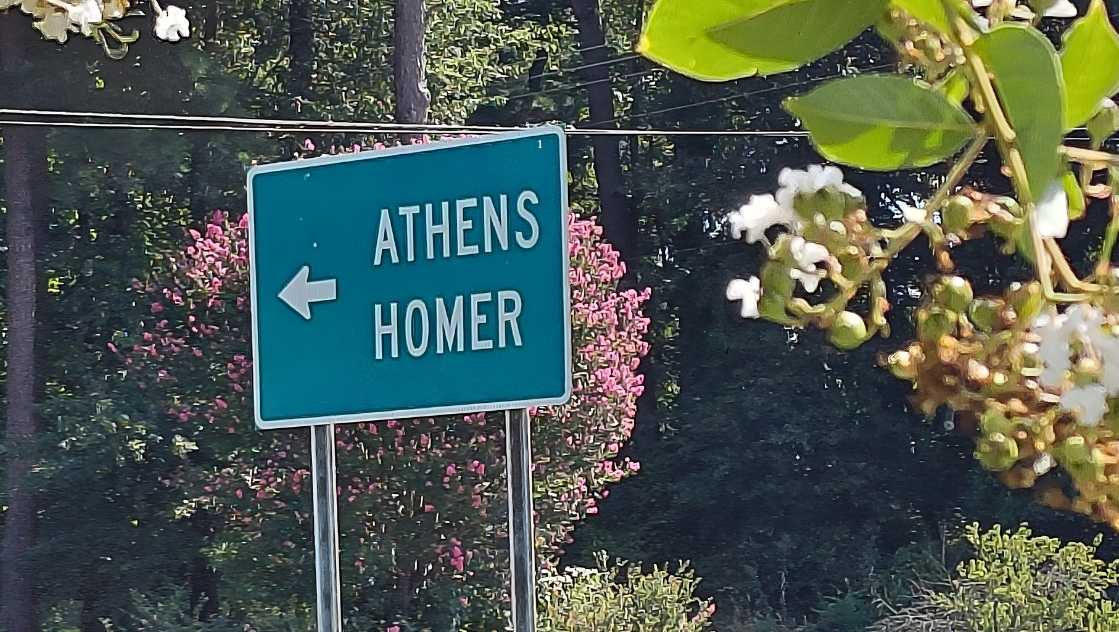
Athens. Homer. Sparta. Arcadia. Corinth. Antioch. Mt. Lebanon. Lisbon. Vienna. You can visit all nine of these references to Classical Antiquity within a few hours exploring the piney woods east of Shreveport (and a tenth location by driving down to Alexandria). How these Louisiana places got aspirational names, and what they offer architecturally, entails the concept of cultural diffusion — that is, the geographical spread of ideas, traits, and practices.

The agents were Anglo-American settlers who hailed from the Northeast or upper South, where a Classical revival had been afoot since the late 1700s. It arrived via England, France, and Germany, where Enlightenment thinkers and artists during the late 1600s and 1700s had found inspiration in Ancient Greece and Rome — as had their predecessors during the Italian Renaissance of the 1500s, thanks in part to the rediscovery of ancient Greek texts.
Manifested in everything from architecture and city planning to art, civics, and literature, interest in Classical Antiquity came to be known broadly as neoclassicism, of which an offshoot gained the name Hellenism and, for architecture, Greek Revival. The greatest American emissary of neoclassicism was Thomas Jefferson, the embodiment of the Enlightenment, who, among other things, influenced a generation of architects wielding the signature Grecian elements of pediments, columns, capitals, entablatures, dentils, and rectilinear fenestration, all serving a sense of symmetry and rationality.
Neoclassicism diffused because it resonated with American ideals and ambitions. According to urban historian Lewis Mumford, Greek Revival in particular reflected “a desire for collective dignity and order, combined with the utmost decorum.” Architectural historian James Marston Fitch viewed the regional popularity of the Greek idiom in a darker light, seeing the “Southern identification with Imperial Rome [and] Periclean Greece [as a] reactionary use of the Classic idiom [which] regarded human slavery as the basis of Classic culture instead of being merely its blemish.”
But like many fashions, neoclassicism soon became detached from its underlying philosophy, and spread instead by sheer aesthetics, especially as widely distributed pattern books showed how to replicate key motifs. Need to build a city hall, church, or bank? By the 1820s, both client and architect would have agreed it ought to look like a Greek temple. Want to make a social statement with your new mansion? Install some Corinthian or Ionic capitals atop pearl-white columns. Seek to imbue your rural hamlet with grandiosity? Name it Alexandria, Sparta, Achilles, or Troy (all in Virginia), or Athens, Sparta, or Troy (all in Pennsylvania), or Athens, Corinth, Ithaca, Syracuse, or Troy (all in New York). In fact, there are at least two dozen Athens toponyms across the U.S., a map of which limns a spatial diffusion from the Mid-Atlantic states westward and southward, just as Anglo-Americans migrated down the Ohio Valley and along the Appalachians into the lower South.
Many more prosperous anglophones sailed coastwise into Louisiana’s biggest city, New Orleans, where Greek Revival had appeared at least by 1814. (The earliest surviving local example is the Thierry House at 721 Gov. Nicholls Street, whose Doric columns and Classical proportions, designed by Henry Latrobe and Arsène Lacarrière-Latour, were rediscovered by architects Richard Koch and Samuel Wilson in 1940.) Farming families of lesser means generally came overland into northern Louisiana, where the terrain was more passable and open for settlement. Unlike the francophone Creoles and Acadians of the boggy coastal plains, these Anglo-Americans thought of themselves as pioneers rather than colonials, travelled by stagecoach instead of boats, built log cabins rather than cross-timber cottages, and named their settlements not for Catholic icons but for the Classical allusions popular back home. And so the communities of Athens, Homer, Sparta, Arcadia, Corinth, Antioch, Mt. Lebanon, Lisbon, and Vienna, among others, blossomed in the verdant woodlands of northwestern Louisiana.
No records divulge the explicit reasons for each of these town names, but it stands to reason that their founders had a mutual cause. The towns’ geographies are intriguing on a number of levels. As Claire D’Artois Leeper pointed out, “Arcadia, La., is located between Sparta, in Bienville parish, and Athens, in Claiborne parish, just as Arcadia in Greece is located between Athens and Sparta.” Given that their post offices were all established during 1850-1851, around the peak of Greek Revival, Leeper contended “this geographical parallel … is no coincidence,” reflecting instead an explicit homage to Classical Antiquity.
Relatedly, most of the surviving antebellum buildings in these communities embody revived Greek influences. The best example is in Homer, founded 1849, named for the Greek poet, and designated as parish seat of Claiborne Parish. Within a decade Homer became “picturesque and pleasant,” according to J. W. Dorr, who visited in 1860 — “a very prosperous town of seven or eight hundred inhabitants” living around the big courthouse under construction at the time. Completed in 1861 at a cost of $12,304, the whitewashed brick edifice (1-4 on accompanying map) boasts 20 two-story columns with Doric capitals and a domed octagonal cupola. Inside, the courtroom bears the standard Greek elements of keyhole doorways and a broken-pediment-and-finial aedicula behind the judge’s bench. Now home to 2,500 people, the town of Homer boasts a vibrant commercial district surrounding its stately courthouse square.
Ten miles south of Homer is (Old) Athens, founded in 1846 at a site that made it the highest community in Louisiana, 415 feet above sea level. It may have been named because its hilltop position brought to mind the setting of the Acropolis in Athens, Greece, or because both locales had been selected for their natural springs. But Athenians at the Louisiana site upped and moved when new arteries formed to the east, giving rise to (new) Athens, today a village of 230 people (5-6 on map). The only trace remaining at the original site is the Old Athens Cemetery (7 on map), which, like many historic burial grounds in this region, still has a chain-link fence dividing its traditionally segregated sections.
The largest of our modern-day Classical communities, Arcadia (population 2,650), originated as a stagecoach stop in the 1820s and became a town in 1854, benefitting from its status as Bienville Parish’s seat as well as its position midway between Monroe and Shreveport. The smallest is Mt. Lebanon, founded in 1836 by farmers from South Carolina as a stopover on the Old Stagecoach Road, and now with only 80 or so residents. Yet Mt. Lebanon has “eight good substantial representative examples of the provincial Greek Revival,” wrote researchers of a 1979 National Register of Historic Places Inventory, “a remarkably high number and concentration for northern Louisiana.” Among them is the Country Gothic-style Mt. Lebanon Baptist Church (8 on map), organized in 1837 and host of the 1848 Louisiana Baptist Convention, which five years later launched Mt. Lebanon University and an affiliated Female College. Along the adjacent Old Stagecoach Road are a number of circa-1840s homes (9-11 on map) exhibiting “Greek Revival details including molded capital pillars and pilasters, transom side-lighted doors, six-over-six windows and plain molded mantels” as well as American-style “central hall double parlor plans, under pitched roofs with five bay gallery fronts [and] the occasional pediment.” Mt. Lebanon’s university closed in 1861, and in the 1880s, the hamlet began losing residents to Gibsland, three miles to the north, where the Vicksburg, Shreveport & Pacific Railroad decided to site its station. Like Old Athens and ancient Athens, Mt. Lebanon became antiquated.
And then there is Sparta, which ended up, well, spartan. Founded in 1849 for no other reason than to serve as the seat of Bienville Parish, Sparta seemed doomed as early as 1860, when visitor J.W. Door rued that it had been “unhappily located far from any navigable watercourse” and built “in a regular old-fashioned sand-bed…It would not be surprising if, two or three generations hence, Spartans were born splay-footed.” Instead, Spartans voted with their feet and departed after they lost the Bienville Parish courthouse (now in Arcadia). Nature has since reclaimed their sandy-bottomed site, and like Old Athens, Old Sparta (12 on map) is now marked only by its cemetery — also with a chain-link fence separating its graves.
Greek Revival declined as Jeffersonian America gave way to commerce and industry, as architects found new inspiration in Romanticism, and, in Mumford’s words, as “the decay of public life … became so painfully evident after 1840.” The subsequent rise of Jacksonian democracy, which valorized the common man and looked askance at aristocracy, made Greek temples look increasingly passé by the late 1850s. The Classical idiom held on a bit longer in the South, until the fall of the slave-holding regime — after which Italianate designs diffused similarly, from European Romanticists to the Northeast and down southward into New Orleans.
Yet Greek motifs, however pastiche, endure in façade adornments, and many people today expect to see them on certain structures even if they cannot explain why. You don’t have to drive too far from Homer, or Athens, or Arcadia to find a modern bank, or church, or school trying to imbue gravitas by invoking Classical Antiquity.
Richard Campanella, a geographer with the Tulane School of Architecture and Built Environment, is the author of “Crossroads, Cutoffs, and Confluences: Origins of Louisiana Cities, Towns, and Villages,” “Draining New Orleans” and other books from LSU Press. Campanella may be reached through richcampanella.com, [email protected], or @nolacampanella on X.