

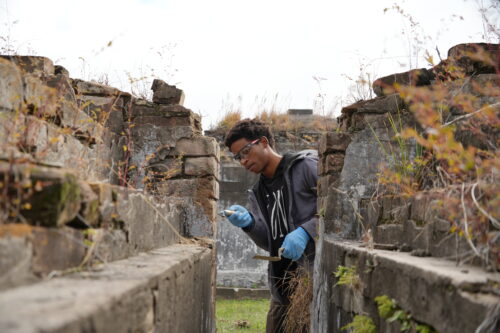
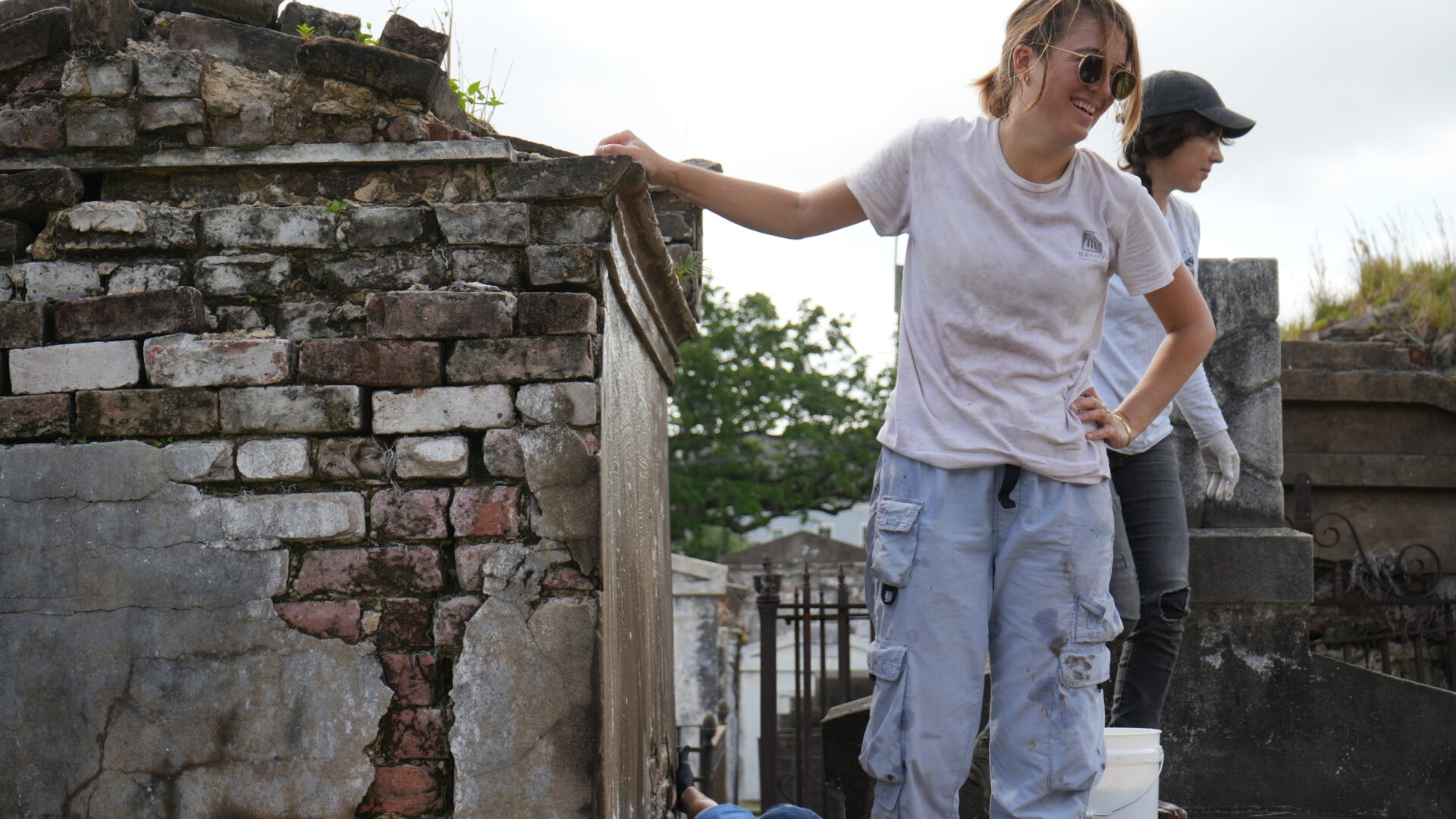
As a lead conservator for Bayou Preservation, Juliette Hotard restores paintings, masonry, stone and more across the city.
This work extends into New Orleans’ historic cemeteries, where Bayou Preservation takes on projects of all sizes, ranging from cleaning and patching stucco to restoring tablets and full roof reconstruction.
Hotard earned her degree in historic preservation and community planning from the College of Charleston and worked with Save Our Cemeteries first as an intern and later as the Restoration and Volunteer Coordinator. As a native New Orleanian, her connection to the city’s cemeteries is personal as well as professional, since her family holds the deeds and cares for many tombs here.
The oldest of these is the Caffin tomb in St. Louis Cemetery No. 2, with burials dating back to the mid-1800s. Like so many historic tombs, it has weathered from years in the city’s harsh climate. And like so many New Orleans families, Hotard’s wants to make sure it survives well into the future by working this year to carefully restore it.
It’s not always a quick or easy process, but it can be done with the proper steps.
Hotard and her family first located the deed and applied for a work permit with the Archdiocese of New Orleans, which owns the cemetery.
She is now working to remove and replace failing plaster and mortar joints, clean away vegetation and reconstruct the roof, which has posed the biggest challenge.
As weeds grew on the tomb, they reached under the plaster and ate away at the mortar, uprooting the bricks. To repair the roof, Hotard had to remove it completely to then sort, clean and re-lay the bricks.
Her experience and expertise can provide helpful guidance for any tomb owner looking to maintain or restore a family tomb.
As many New Orleanians visit and tend to their family tombs on All Saints’ Day on Nov. 1, now is a great time to learn how best to care for these historic structures on a regular basis.
Locate the deed to ensure ownership of a tomb and speak with the cemetery owner before embarking on any major restoration project. However, there are some easy beginning steps that any tomb owner can take to care for and maintain these historic structures:
- Visit tombs regularly to check for new weeds or other arising issues.
- In caring for vegetation, it is okay to pull small plants growing on the tomb, but avoid pulling plants at the parapet, cornices or roof, where roots may have compromised the structure. Avoid using weed killer, which can be harmful to the masonry. Instead, spray weeds with a mixture of household vinegar and water. A little vinegar goes a long way.
- Polished marble tablets will weather in this salty, subtropical climate, and it is normal to see staining or sugaring. Do not use bleaches or stronger cleaners, which will disintegrate the stone over time. Instead, use a mild, diluted non-ionic detergent like Orvus, soft, natural bristle brushes and low-pressure rinses.
Professional help is available for anyone who may not be able to care for a tomb on their own.
As Hotard noted, preservation is an ongoing practice that can be practical and attainable. Taking small, consistent steps to clean tombs and maintain vegetation can prevent the need for big ticket projects down the line and helps to preserve New Orleans cemeteries for generations to come.
Sara Lowenburg is director of the PRC’s Save Our Cemeteries department.