

In July 1901, a federal pension agent took the train from New Orleans to a rural settlement 50 miles upriver from the city known as Vacherie.
Beckford Mackey, a native of Texas and former consul to Costa Rica, worked for the United States Bureau of Pensions. He had been tasked with examining the case of Edward Gros. Gros had applied for benefits under the 1890 Pension Act, which entitled disabled veterans of the Civil War to a federal pension.
Mackey stepped off the train at Vacherie Station into a world that was foreign to him. Vast fields, green with sugar cane, rose around him. He made his way to Gros’ home at Laura Plantation, one in a long line of double rows of cabins back in the fields near the sugar mill.
Gros had been born into slavery in one of the cabins around 1835 and continued to reside there with his family after the Civil War. Mackey discovered that Gros, like so many formerly enslaved men from south Louisiana, spoke a Creole dialect that made it difficult for him to communicate the issues that had arisen with his pension benefits.
Gros had been a cooper — a craftsman who produced wooden casks, barrels and other similar containers — during enslavement but later held the esteemed position of sugar maker on the plantation. By the time he met Mackey, he was too infirm to work, necessitating some means of support.
During the Civil War, the United States regained New Orleans in April 1862. Confederates fled into the western and northern parts of the state and continued to threaten U.S. control of south Louisiana. Members of the Louisiana Native Guard, two regiments of free men of color from New Orleans, offered their services to the U.S. cause. The Louisiana Native Guard became part of the U.S. Army and began enlisting not only free men of color but also formerly enslaved men. The Second Louisiana Native Guard was sent to guard the railroad and prevent guerilla action near Laura Plantation.
Inspired by the Native Guard, Edward Gros left the plantation for New Orleans and enlisted in the Third Louisiana Native Guard. Two other men also born and raised on Laura Plantation, Daniel Howard and Jean Baptiste Peterson, accompanied him. Their regiment was later renamed the 75th United States Colored Infantry. They fought at the Battle of Port Hudson, the first time Black men saw action during the Civil War. Their regiment’s valiant service was the subject of an article in The New York Times and became a powerful means of recruiting Black men.
Edward Gros and his comrades in the 75th USCI were not the only men from Laura Plantation to fight for freedom. Austin Wilson, sold south from Virginia to Louisiana through the domestic slave trade, stood on the levee in front of the plantation and watched federal gunboats pass. He swam out to one and asked to join the U.S. Navy. He served for the duration of the war on board the USS Itasca. Like Wilson, Joseph Isom had been separated from his home and family through the slave trade but managed to adapt to life on the plantation. The oldest of the men from Laura to serve, Isom had a wife and children when he enlisted in the 96th USCI.
Several of the men from Laura Plantation served with great distinction, even attaining the rank of non-commissioned officers. Justin Stewart, son of an enslaved domestic named Manon and trained as a carpenter, was sergeant of his company in the 84th USCI. He would later become a prominent member of the plantation community and an elder in the Baptist church. Zenon Doctor, whose grandparents were from Africa and among the first people enslaved on the plantation, also enlisted in the 84th. Justin Stewart’s younger brother, Bernard, followed in his footsteps, becoming a sergeant in the 80th USCI. Bernard did not return to the plantation after the war; instead he relocated to New Orleans and worked as a screwman loading cotton onto boats on the docks. The Stewart brothers learned to read and write during their time in the U.S. Army. Like Bernard Stewart, Auguste James did not occupy one of the cabins at the time of Mackey’s visit. James, a veteran of the 80th USCI, moved to a plantation further upriver, where he raised a family that included sons who would fight in World War I.
Bernard Mackey met with Edward Gros as well as several other veterans during his visit to the quarters that housed the formerly enslaved and their descendants. Gros and his fellow soldiers, old and infirm, faced a new battle, that of proving their identities and their right to federal pensions. It was an uphill climb, fraught with prejudices based on their race and their native language, but they prevailed.
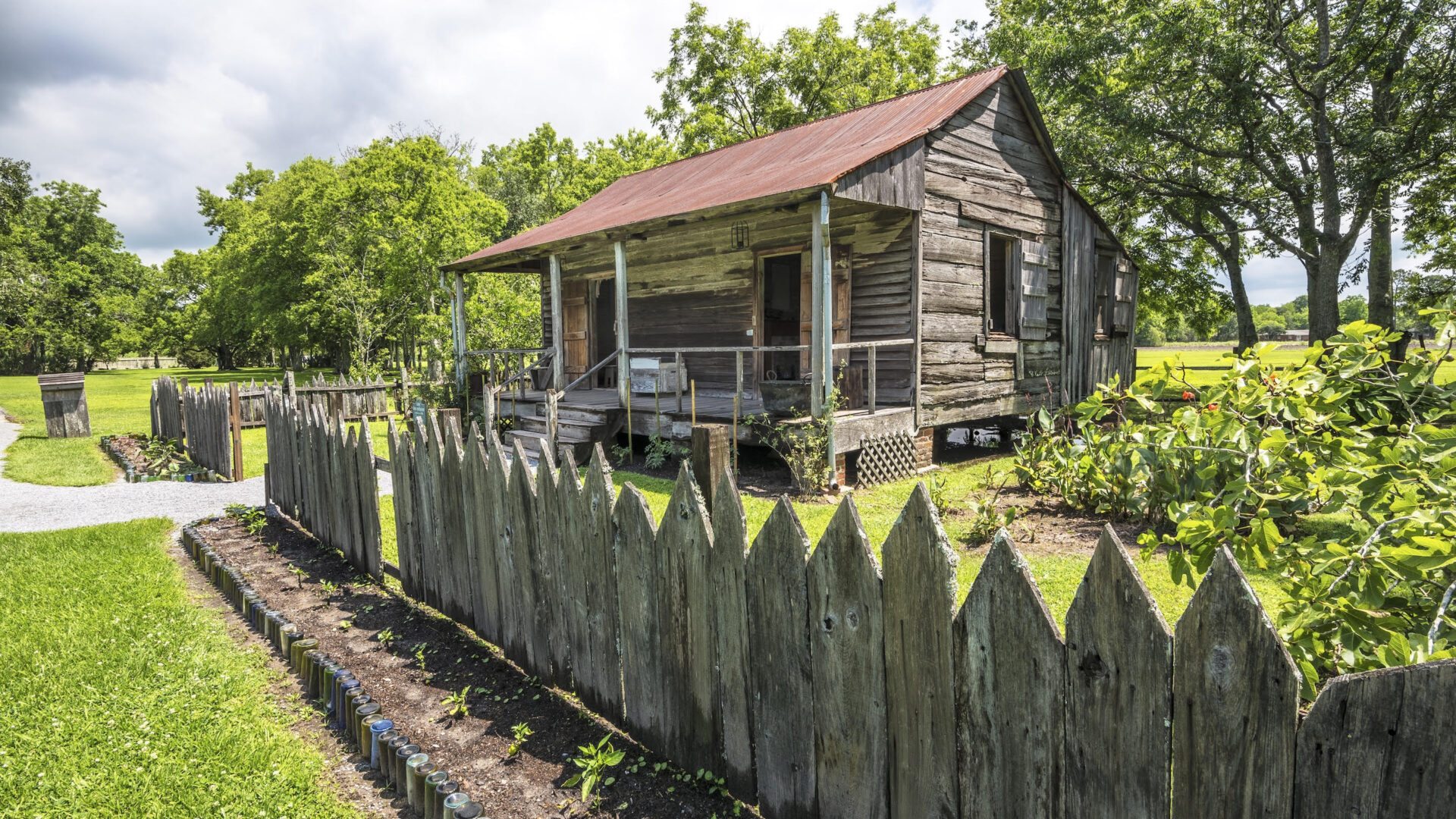
Today at Laura Plantation four of these cabins remain. They were moved from where they sat deteriorating in a back field and restored in the late 1990s by Norman and Sand Marmillion as part of their efforts to preserve Laura Plantation. On Veterans Day, the area around the cabins will be the setting to commemorate the enslaved veterans of Laura Plantation and of the United States Colored troops. At 10 a.m. on Nov. 11, Laura Plantation will join with the African American Civil War Memorial and Museum in Washington, D.C., for a reading of the names. Laura has adopted the 75th United States Colored Infantry; the names of over 1,000 soldiers will be read aloud, including those of Edward Gros, Jean Baptiste Peterson, and Daniel Howard, all born in the cabins at Laura Plantation. A plaque will be dedicated in their honor. Community members, descendants and members of the public who wish to honor these brave men and learn more about their lives are invited to attend.
Katy Morlas Shannon is the author of the new book “Invisible Blackness: A Louisiana Family in the Age of Racial Passing.”