




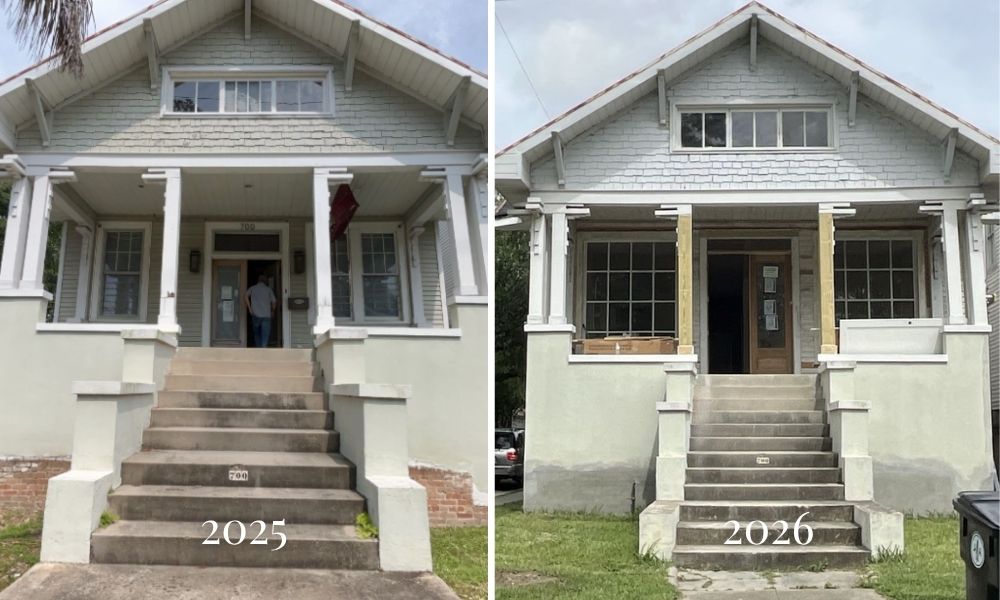
DISTRICT A Councilmember Aimee McCarron championed New Orleans’ historic district regulations in July, filing a motion that would have required the owner of a historic Craftsman-style bungalow Uptown not only to reverse unsanctioned façade alterations, but also to pay a $15,000 fine.
McCarron filed the motion in anticipation of the July 9, 2026, City Council meeting. Before the hearing, the owner of 700 Webster St., 700 Webster Street LLC, withdrew its appeal. As a result, the owner still must restore the façade but avoided the fine.
Although the financial penalty will not be imposed, McCarron’s motion sent a clear message from District A that historic district regulations must be followed. In a statement to PRC, she said, “The demolition of the facade did not occur from storm damage, via a miscommunication between city departments, or through contractor error. It stemmed from simply and intentionally working outside of the approved plans. I am committed to upholding historic district regulations when the rules are so blatantly broken, and I hope the proposed $15,000 fine will serve as an example for others who contemplate skirting the law.”
The owner appealed to the City Council to reverse a June 3, 2026, Historic District Landmarks Commission decision requiring the LLC to restore the front façade. Unpermitted and inappropriate alterations resulted in the loss of historic doors and windows, as well as a transom. At that meeting, PRC urged the commission also to levy an appropriate fine for disregarding historic district regulations. Uptown Commissioner Tim Lupin ultimately declined to include the Tier 1 penalty of up to $21,904 in his motion, even though it was recommended by HDLC staff.
During the HDLC meeting, the applicant said they did not know the building was in a regulated historic district, despite having submitted plans to HDLC for review and approval. Several neighborhood advocates spoke in opposition to the alterations. Commissioners raised concerns that significantly widening the front windows may have compromised the building’s structural integrity. Although outside HDLC’s purview, public commenters also raised life-safety concerns related to construction at the site, including suspected hazardous lead-paint exposure.
Applications to retain unpermitted work after the fact, known as “retentions,” are an avoidable drain on already limited city resources. At this property, HDLC guidelines and regulations were ignored, inappropriate work was completed without a permit and historic building materials were sent to a landfill. The applicant then sought an exception to rules that most property owners in New Orleans follow without special treatment.
Issuing fines is HDLC’s primary enforcement tool. Fines deter applicants — and others — from undertaking unpermitted work on future projects. They also hold LLC property owners who do not follow the rules accountable for the extra city time required to follow up on projects that were not properly permitted. Enforcing the fine structure helps establish clear expectations for work in historic districts, and PRC applauds McCarron for recognizing that and taking a tangible step toward that goal.
This was not the first time the property came before HDLC. In June 2025, the commission denied a full-demolition request from a prospective owner. At the time, an HDLC inspector noted in his report that the applicant indicated the HDLC process was a steppingstone toward City Council approval for buildings that were not good candidates for demolition. McCarron’s response to the latest appeal is a clear rejection of that idea.
We look forward to seeing the owner return the façade to its historic appearance.