

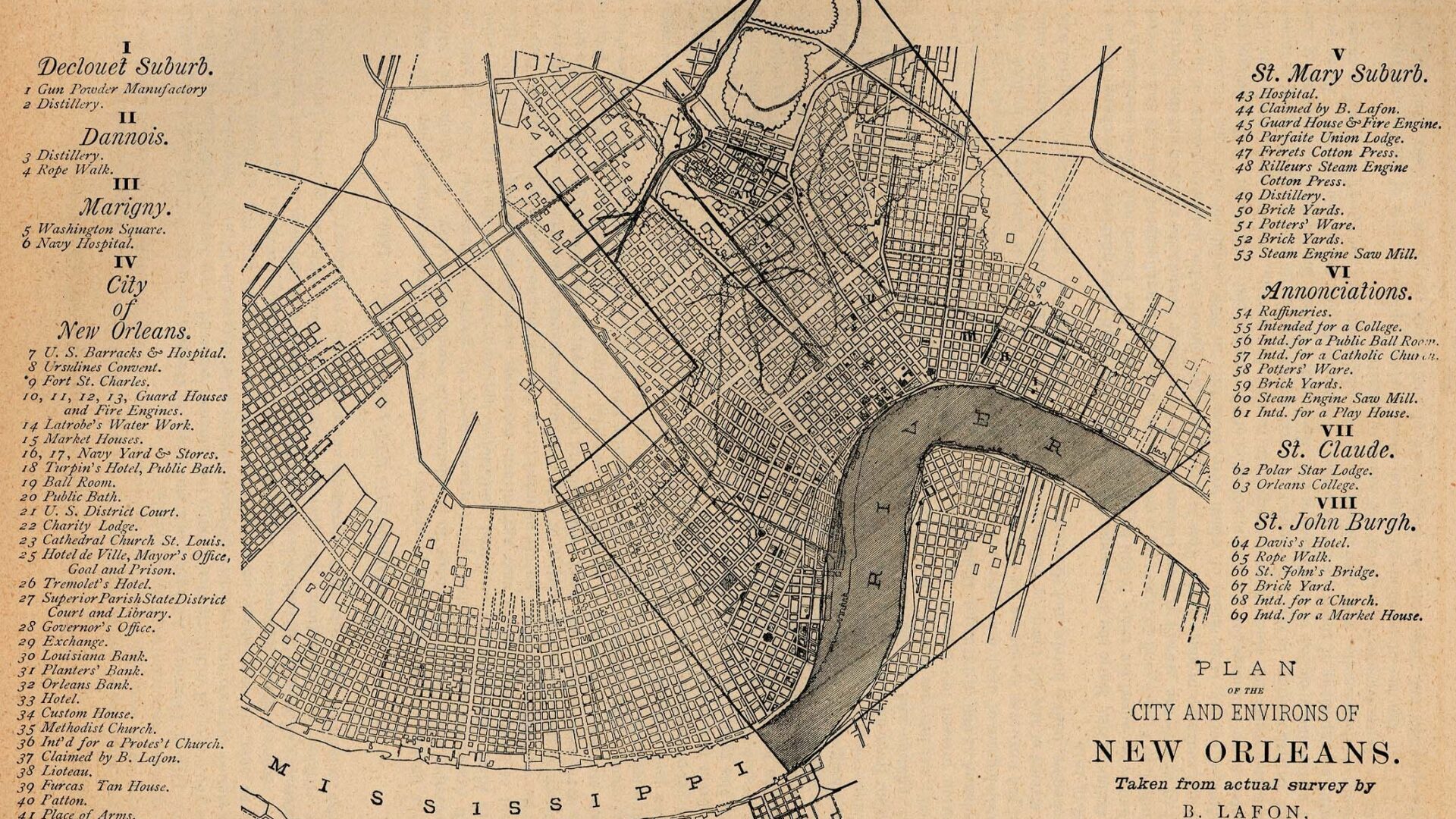
The tallest building ever constructed in New Orleans is the Hancock Whitney Center, at 697 feet. Completed in 1972, it contrasts sharply with the longest building in New Orleans: a structure called simply “The Rope Walk,” completed in 1808 and stretching nearly four city blocks. The Hancock Whitney Center remains a visible symbol of commercial New Orleans. By contrast, the Rope Walk has vanished from memory, and its curious function is all but unknown in our modern world.
What was a rope walk? In the era of clipper ships and other sailing vessels, there was an inexhaustible demand for rope. The USS Constitution, launched in 1797, required several miles of rope. When steamboats appeared on America’s inland waters, demand only increased. Rope was needed to hold cotton bales and other cargo in place and to tie up ships in port.
How was this seemingly limitless demand to be met? Ropes of all sizes were made by twisting separate strands into a single cord. Boatmen and ship owners demanded long, powerful ropes with no knots or splices along the way. The only way to produce such a product was to build a rope walk. These structures, made of wood, brick or stone, were often less than 10 yards wide and up to 20 feet tall, but could stretch for up to four city blocks. Workers moved up and down the entire length, making sure the twisting machinery did its job.
The first rope walks were in England, but they soon appeared in Holland, Germany and Scandinavia. In 1837, the U.S. Navy commissioned construction of a quarter-mile-long rope walk in Boston. New Orleans, with scores of river steamers tying up at the Vieux Carré and equal numbers of tall ships docking in what is now Bywater, was a natural base for a major rope industry. It was probably inevitable that New Orleans entrepreneurs would seize the opportunity and build a classic rope walk in an undeveloped area of what is now Marigny. The new Rope Walk began near the river, near what are now Spain and St. Ferdinand streets, and stretched for nearly three blocks inland to the north-northwest.
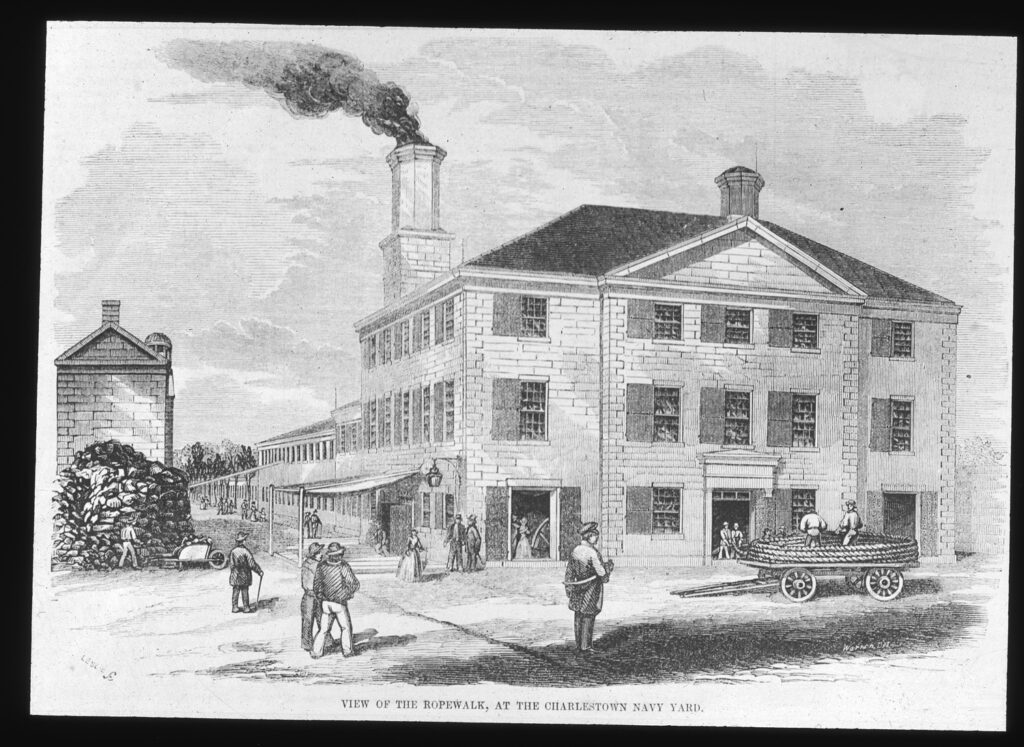
Demand for rope was enormous, and New Orleans’ Rope Walk offered employment to more than 100 men. No less important, the strongest rope was woven from hemp, which created an unquenchable demand for that crop. Many local farms and plantations made haste to switch to hemp, which required far less labor than indigo, sugar or cotton. Thus, the St. Domingue-born owners of Lombard Plantation in today’s Bywater became major producers. They were growing not the smokable hemp associated today with cannabis use, but industrial hemp, known scientifically as Cannabis sativa, which contains less than 0.3% THC (tetrahydrocannabinol), the psychoactive ingredient in marijuana.
For several decades, New Orleans’ Rope Walk thrived, thanks to mounting demand from the American heartland served by steamboats and from sailing vessels arriving from the East Coast, Europe and the Caribbean. Meanwhile, from 1810 to 1830, steam engines were transforming the local economy. In 1812, the steamboat New Orleans, designed by Robert Fulton and Robert R. Livingston, arrived in the Crescent City. Steamboats proliferated thereafter, and within a few years, steam-powered sawmills, sugar presses and other enterprises lined the river downstream from the Rope Walk. And yet the owners of the New Orleans Rope Walk failed to make the transition to steam power, even though their competitors on the East Coast did so. By 1832, the Rope Walk was defunct, and it was torn down soon thereafter.
Why did the entrepreneurs behind New Orleans’ Rope Walk fail to make the transition to steam power? It cannot be blamed on a lack of local capital, for the number of banks in New Orleans doubled between 1830 and 1835, the very years when the Rope Walk died. Bankers were eagerly extending credit and issuing their own notes. Indeed, in the same year the Rope Walk closed, the Levee Steam Cotton Press opened nearby, funded at $500,000. True, the value of land in what is now Marigny soared during the 1820s, but money was so plentiful that, had the owners wanted to relocate farther downriver, it would not have been difficult to do so. Nor can it be blamed on the nationwide Panic of 1839, for by then the Rope Walk had already been dead for half a decade.
In the absence of more concrete evidence, can we suppose that the owner or owners died in the massive epidemics of yellow fever and cholera in 1832? Some estimates suggest that as many as one out of seven residents of New Orleans perished in that annus horribilis. Even though the economy rebounded thereafter with amazing vigor, it is possible that key investors or managers of the city’s Rope Walk died or lost their fortunes during that crisis.
What is beyond dispute is that the new generation of entrepreneurs and speculators who emerged in the years before the Panic of 1839 were far more interested in the quick profits to be made from downtown real estate and the development of new suburbs than in investing in an emerging technology. This may have led to one of New Orleans’ missed opportunities nearly two centuries ago.
Seen from today’s debates over resilience and investment, the lesson feels strikingly familiar: cities built on water, trade and infrastructure survive only when they adapt.