
In the Garden District, Lafayette Cemetery No. 1 stands as a physical record of this diverse and ever-changing city, a distinct architectural library and, most importantly, an active burial ground and final resting place for generations of New Orleanians. After being closed to the public for seven years, the cemetery will reopen to tours this fall through Save Our Cemeteries, a department of the PRC, now that the PRC has been selected as the sole tour operator for Lafayette No. 1.
The cemetery’s origins are deeply intertwined with the founding and evolution of the city itself. Originally part of Bienville’s land grant in 1718 and later the site of the Livaudais plantation, the area was incorporated in 1833 as the City of Lafayette. That same year, the plot between Washington, Sixth, Prytania and Coliseum streets was designated as a cemetery. Today, Lafayette No. 1 is the oldest of the city’s seven municipal cemeteries.
Through its burials and development, the cemetery reveals the growth of the surrounding Garden District and city. Notably, Lafayette Cemetery No. 1 did not — and does not — segregate based on race or religion. The people interred within its walls represent the diverse city around it, including immigrants from more than 25 countries and Americans from at least 26 states. The cemetery also reflects the wider community’s trials, such as the impact of yellow fever in the 19th century. Its notable society tombs, including the German Presbyterian and Odd Fellows Society Tombs, represent community and professional groups that shaped the neighborhood.
These tombs, along with the family tombs, copings and wall vaults that make up the cemetery, are both records of the people interred within and examples of the distinct architectural traditions of our mortuary landscape. Above-ground burials reflect both the geographic demands of the high water table and cultural traditions with French, Spanish, African, Caribbean and Creole influences.
Tombs across Lafayette No. 1 showcase Gothic and Greek Revival architecture, intricate ironwork and building materials drawn from both local and international sources. With no naturally occurring stone in New Orleans, tombs have traditionally been constructed of locally sourced clay vitrified into brick and lime-based mortar and plaster made in part from oyster shells. These materials, while locally sourced and responsive to the environment, require ongoing care and maintenance in our harsh, moist climate.
Since its founding in 1974, Save Our Cemeteries (SOC) has played an active role in preserving Lafayette No. 1, where we have restored more than 50 family and society tombs to date. In 1996, the World Monuments Fund (WMF) listed Lafayette No. 1 on its Watch List of One Hundred Endangered Sites and granted funds to SOC to support a preservation plan for the cemetery. Following Hurricane Katrina, SOC continued this work by investigating site drainage problems and restoring tombs in collaboration with WMF, the Preservation Trades Network and the American College of the Building Arts. Now a department of the Preservation Resource Center (PRC), we are committed to continuing this work within Lafayette No. 1 and across the city.
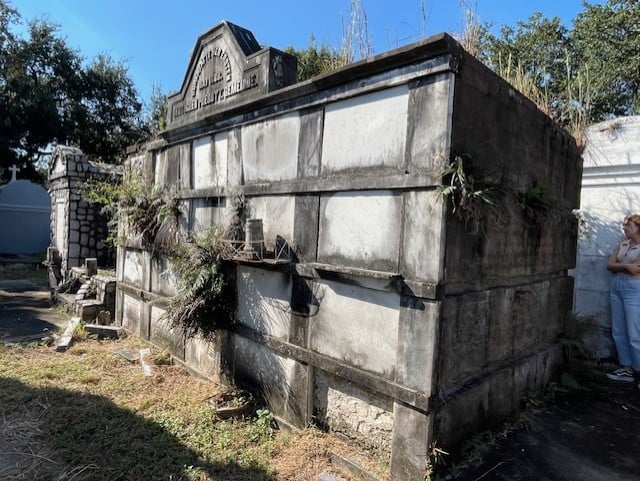
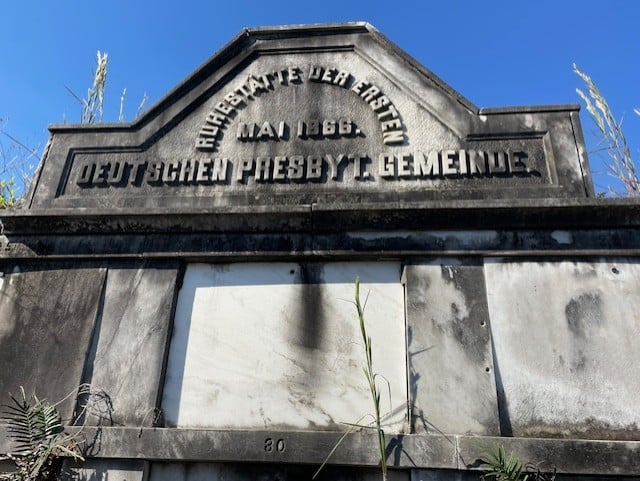
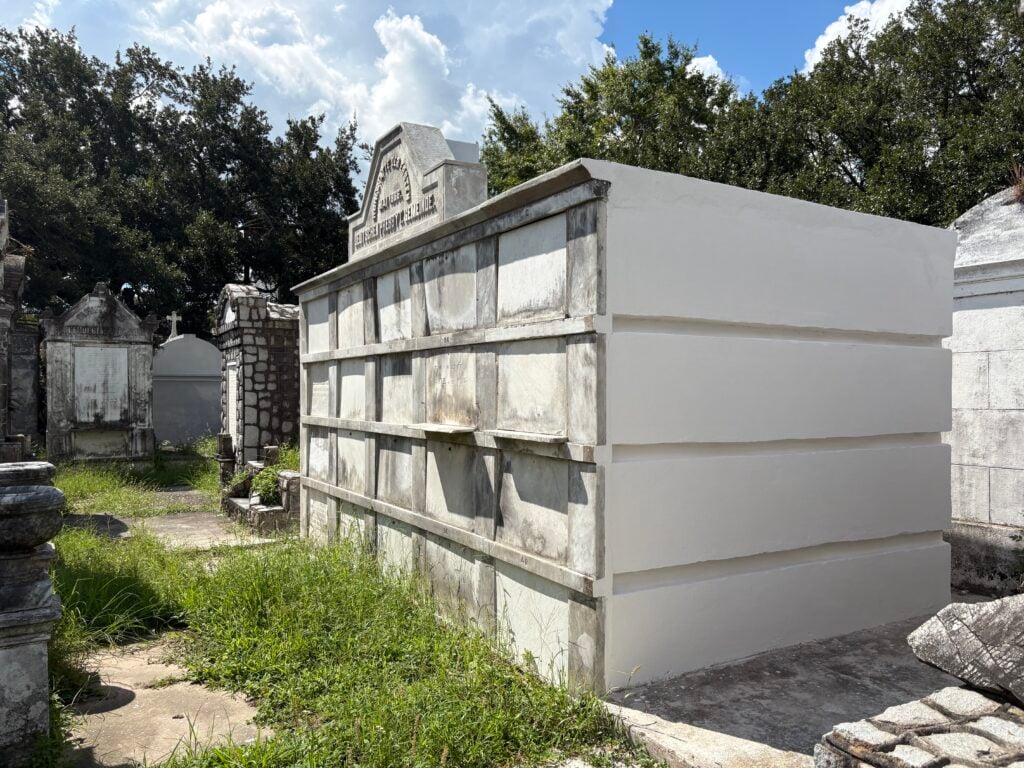
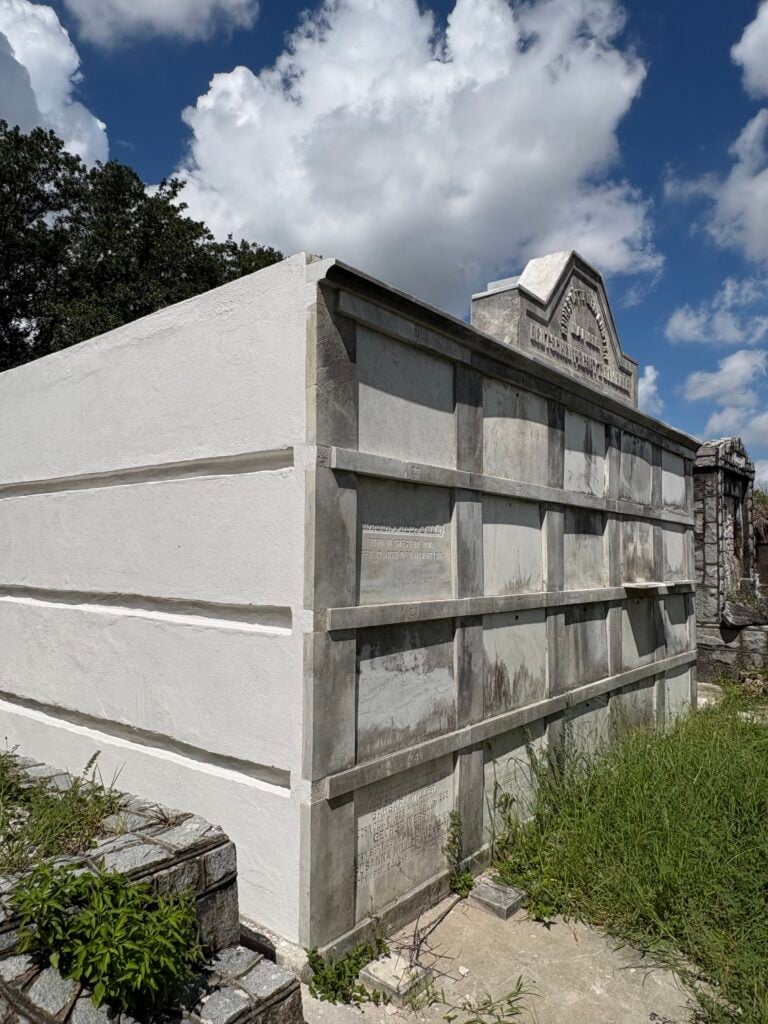
German Presbyterian Society Tomb prior to restoration.
Close-up of the German Presbyterian tomb’s pediment in Lafayette Cemetery No. 1, featuring the inscription “Deutschen Presbyt. Gemeinde” and “Mai 1866” above weathered marble burial panels.
Side view of the German Presbyterian tomb in Lafayette Cemetery No. 1, showing newly restored white stucco.
Rear and side view of the restored German Presbyterian tomb in Lafayette Cemetery No. 1.
This summer, PRC funded the full restoration of the German Presbyterian Society Tomb in Lafayette No. 1, a 20-vault Gothic Revival tomb erected in 1866 to house the remains of low-income German immigrants. Today, the Presbytery of South Louisiana owns and maintains the tomb and, thanks to PRC’s work, will reopen it for burials for families in need.
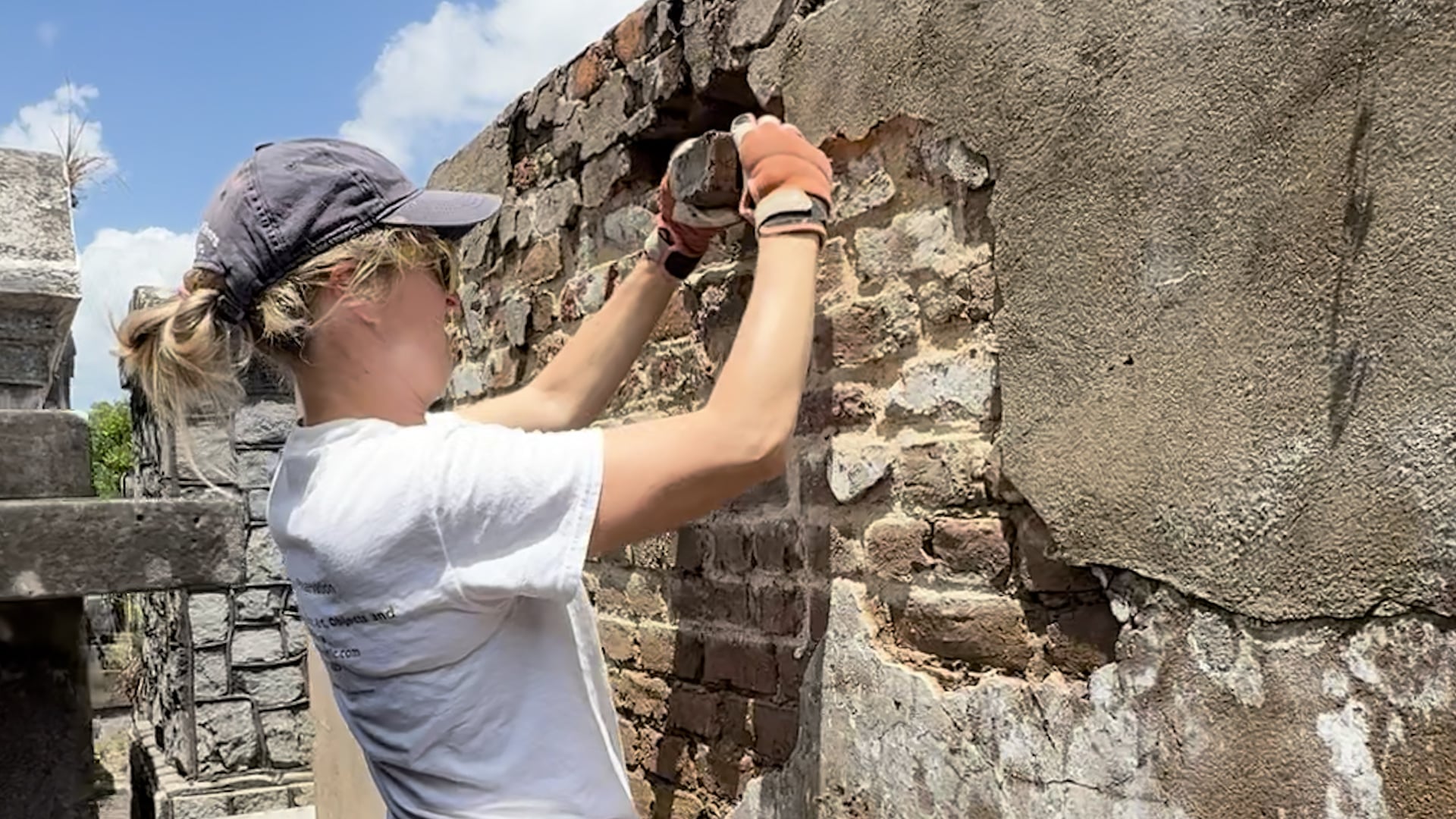
PRC worked with Bayou Preservation and Nola Cemetery Renewal to repoint failing joints and reapply plaster, repair the sloped roof and scupper for proper drainage, reopen several vaults for continued use and clean the entire tomb.
Lafayette No. 1 closed to public visitors in 2019 in response to growing concerns of overtourism and ensuing vandalism, but it Though it has been closed to the public since 2019, Lafayette Cemetery No. 1 remains an active burial ground, a gathering space for families and an important historic landmark. Groups such as the Lafayette Cemetery No. 1 Tomb and Coping Owners Association help preserve the space through cleanup days and advocacy.
In order to reopen the cemetery in a controlled, thoughtful capacity, the City of New Orleans has opted to contract with a sole tour operator, and after a public bid process, they have selected the PRC’s Save Our Cemeteries department. Driven by our mission to preserve and protect New Orleans cemeteries through inclusive education and restoration, the PRC will lead small groups on daily tours, highlighting the historic importance of this cemetery, its architectural significance and diversity, and its ongoing function as an active burial ground. By working directly with tomb owners, neighbors, and local businesses, we will ensure that tours at Lafayette No. 1 – like all of our tours – directly support the ongoing preservation and care of this historic space. As the only non-profit cemetery tour operator in which tour revenue directly supports tomb restorations, these tours will also ensure that we can continue and expand our restoration efforts both within Lafayette No. 1 and across New Orleans.
Through ongoing preservation efforts, upcoming volunteer days, historically grounded tours, and collaboration with tomb owners and the neighborhood, PRC and Save Our Cemeteries will continue to preserve and protect this essential space for generations to come.