
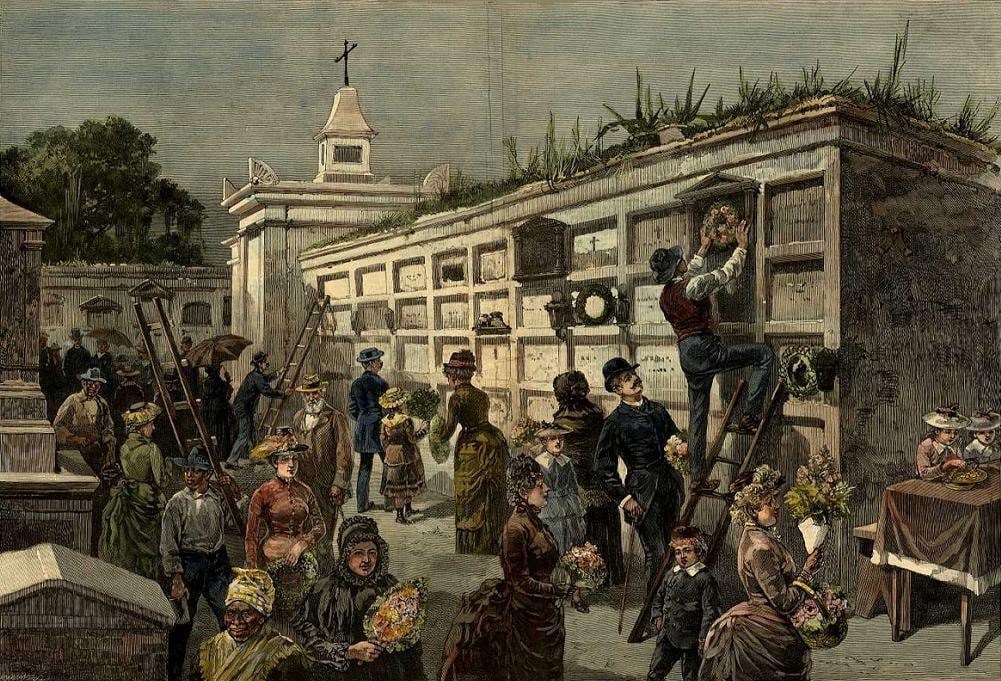
In the early 19th century, New Orleanians woke up early on the first day of November to honor a singularly important holiday. Food vendors lined the streets selling coconut and pecan pralines, calas (rice cakes) and estomac mulatte, or “stage-planks,” which were cakes made with molasses, lard and ginger. La Biere Creole (“Creole Beer”), a beverage made from pineapple pulp and juice, was a popular drink.
Florists loaded their carts with bouquets of roses, chrysanthemums and dahlias, along with garlands of sweet olives and cypress, then took to the streets calling, “Flowers. Fresh flowers!” Meticulously handcrafted artificial flowers of silk, velvet and muslin were also for sale.
Boys with rakes, hoes, spades and paintbrushes clustered together, offering their services. Merchants sold balloons, noisemakers and toy skeletons on a stick. Orphans, dressed in their finest, were used to elicit sympathy (and change) as they lined up next to tables where nuns sat with donation jars for the orphanage. Women, dressed in the latest fashions, promenaded down the tree-lined sidewalks, talking with friends and watching their children frolic and explore nearby. The courts and banks were closed, but the bars were open in anticipation of one of their busiest days. It was a holiday on par with Christmas and Mardi Gras — All Saints’ Day.
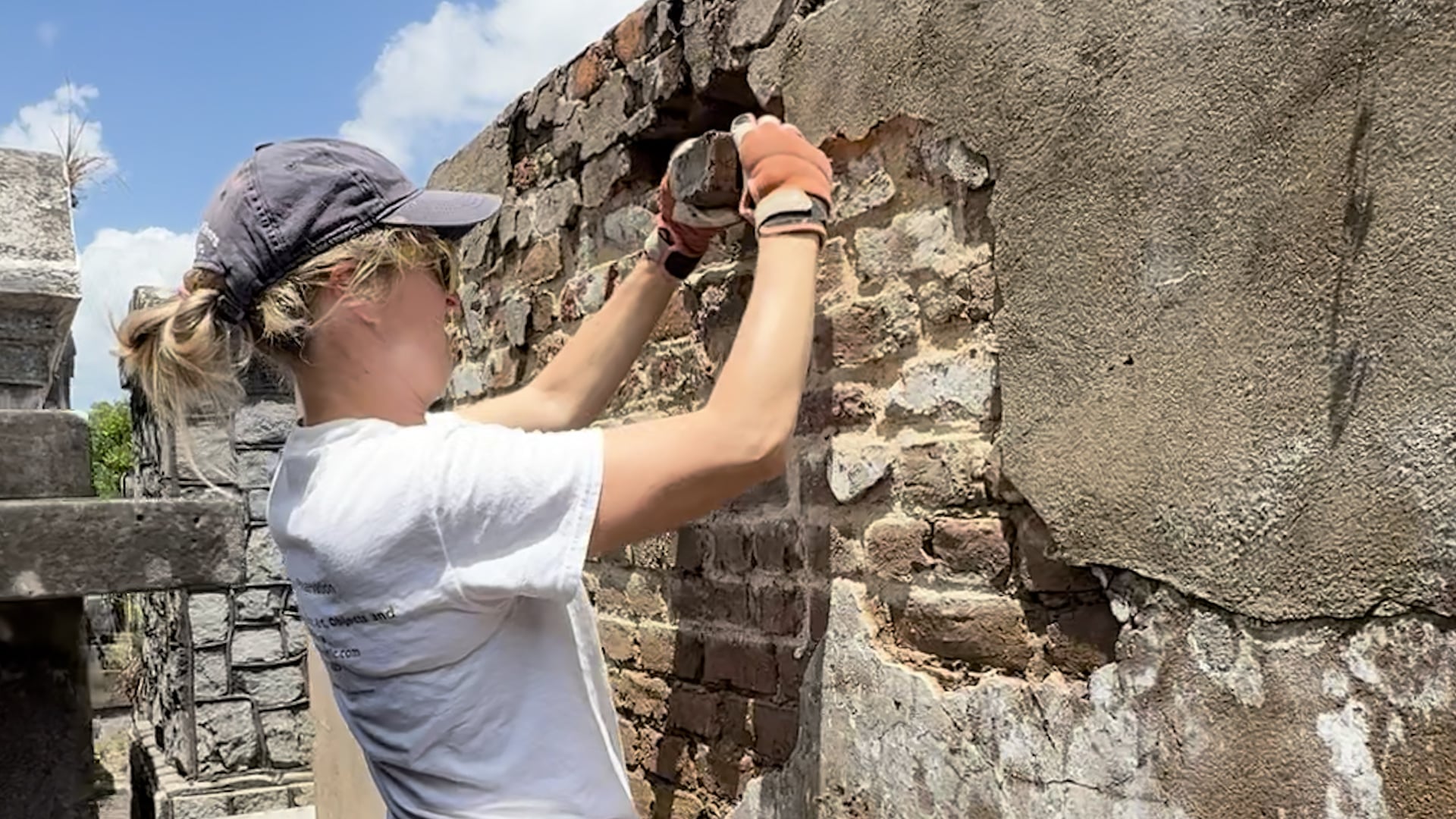
Louisiana is the only state where All Saints’ Day is a legal holiday. It is a holy day dating back to the fourth century. For Catholics, All Saints’ Day is a holy day of obligation, meaning they are required to attend Mass. For centuries, individuals have gathered in New Orleans’ cemeteries on this day to clean and repair tombs, lay flowers and wreaths and light candles.
In 1829, the New Orleans Advertiser reported on All Saints’ Day, stating, “The delightful yet melancholy sympathies and association which it creates, extends to soften and mellow the evil passions of our nature, and leads us to reflect, while gazing on the sepulchers of the dead, on the immutability of human existence.” The article was picked up by newspapers around the country, bringing widespread attention to a local manner of commemoration. Almost immediately, local newspapers encouraged both non-Catholics and non-New Orleanians to take part in this annual observance. Eight years later, an estimated 20% to 25% of the city’s population took part in the Catholic holiday, with observances extending to Protestant and Jewish cemeteries. It had become more distinctly a New Orleans event than a sectarian one and, to some extent, a tourist attraction.
For almost a century in New Orleans, All Saints’ Day combined religious solemnity with the festivity of a social gathering. The collective remembrance also provided financial opportunities for businesses and individuals. Honoring the dead gave the living an occasion to gather — and, for many, a lucrative prospect. Businesses started advertising their wares (flowers, vases, fashion) in newspapers toward the end of September in anticipation of the day. Vendors lined up in the city offices for permits to sell in the street. Cafes and bars near the cemeteries did a bustling business.
After World War II, the event became less social and more solemn. The burgeoning youth culture of earlier decades had provided more outlets for people to gather and interact. Individuals became less dependent on specific events to come together. In turn, All Saints’ Day became less of a large social event.
Attendance and participation in All Saints’ Day started to fall in the 1960s and 1970s with concerns over safety in the cemeteries. Today, All Saints’ Day is experiencing another resurgence thanks to local cemeteries and funeral homes.
The Catholic Cemeteries schedule a blessing of the graves at each cemetery. Since 1979, Metairie Cemetery has held an annual Mass in front of All Saints Mausoleum, with hundreds in attendance.
The staff at Mt. Olivet Cemetery set up tents in the parking lots and offer free food. A DJ plays music all day while approximately 150 to 200 people gather to visit a loved one’s tomb.
For more than 50 years, Rhodes Funeral Home has hosted a Mass and musical at its chapel, with a slideshow of all the deceased it has served that year, followed by a procession to the parking lot.
Jasmine Navarre, director of client services, calls it a “multicultural experience,” but Rhodes plans to change the format in 2026. Navarre explains that “the older generation is just dying out and as I work with their children, they don’t have the same tie to faith.” Rhodes will move away from the full Mass and instead offer a musical and prayer service to adapt to changing sentiment and preserve its service to the community.
Through the decades, with each iteration and fluctuation in popularity, the sentiment of All Saints’ Day remains the same — the remembrance and care of the dead.
Sally Asher is an author, photographer and historian
Want More Stories Like This?
This article was originally published in our award-winning magazine, Preservation in Print. PRC members receive the magazine delivered straight to their door, along with other member benefits—and, most importantly, help support our work to preserve the places and stories that make New Orleans unique.
Memberships start at just $40 a year for students and seniors, and $60 for individuals. Join today and have Preservation in Print delivered to your door while supporting preservation in New Orleans.