A wall that speaks Spanish
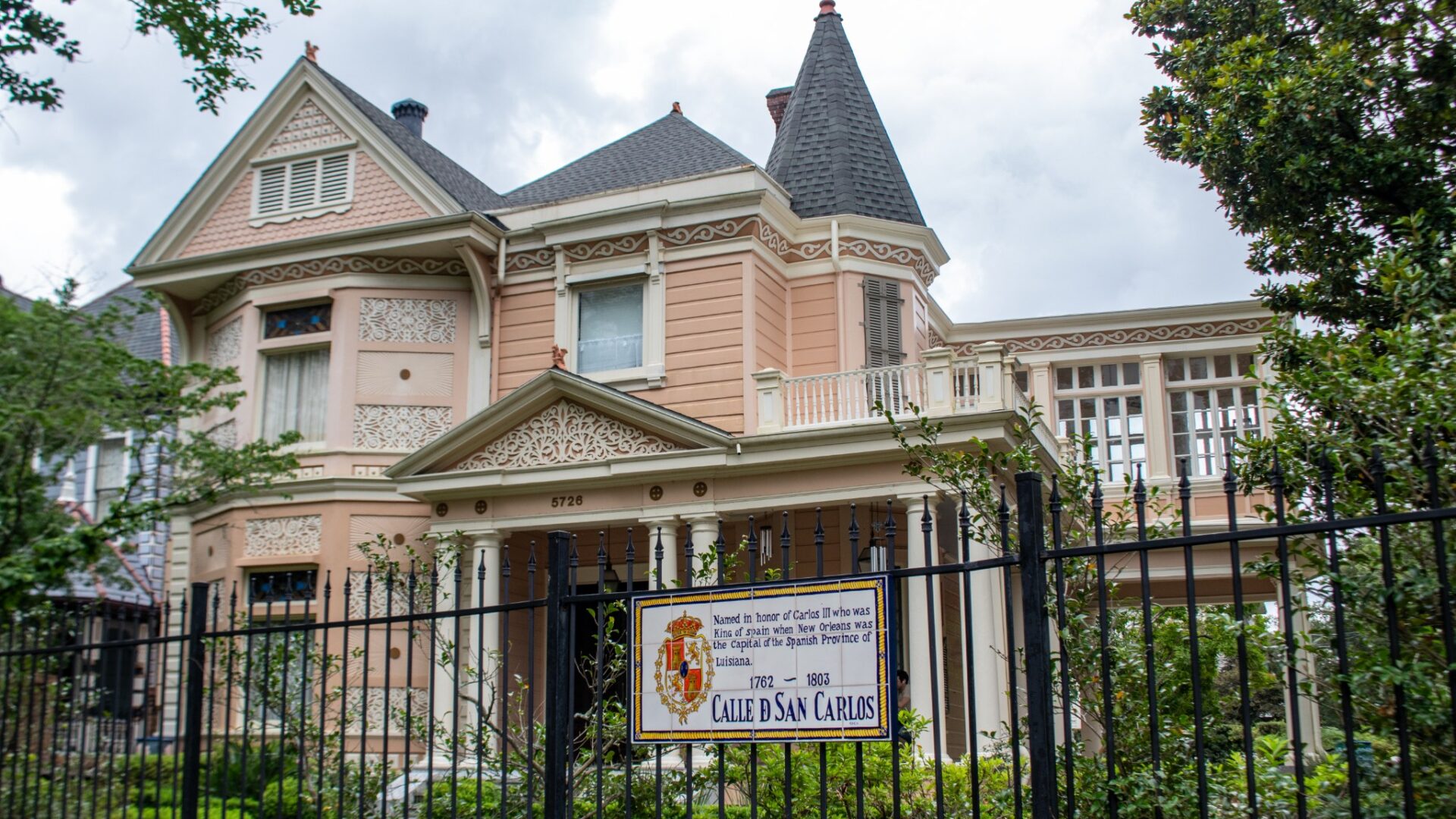
On St. Charles Avenue, amid live oaks, streetcars and the long procession of houses that make the avenue one of New Orleans’ great public rooms, two new ceramic plaques ask passersby to read the street another way: Calle de San Carlos.
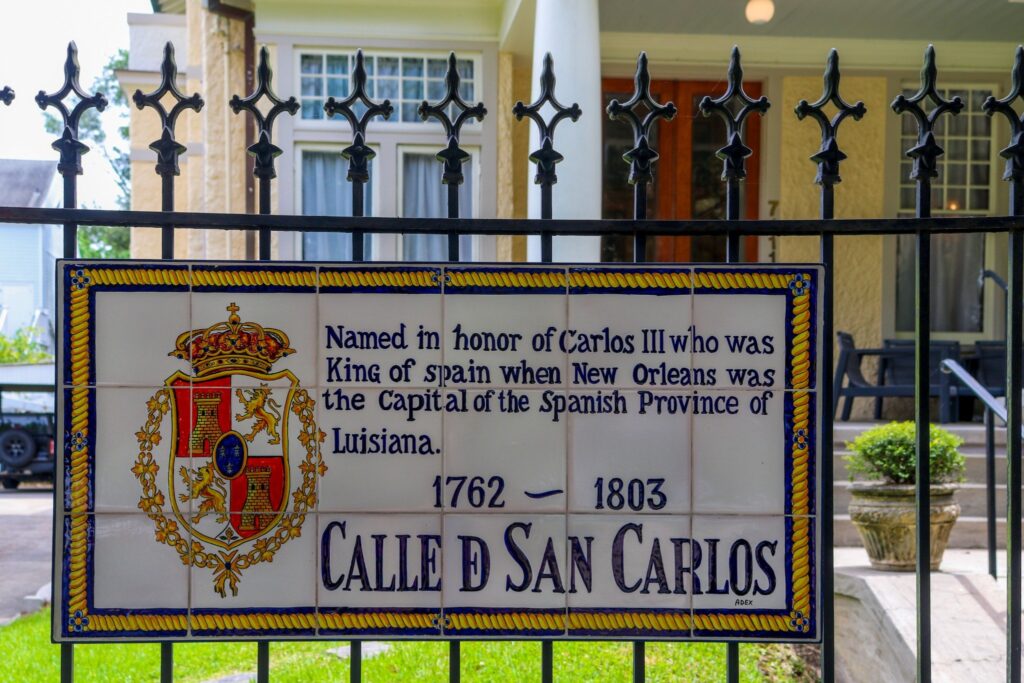
The plaques, installed in May 2026 at 7111 and 5726 St. Charles Ave., aren’t large. They don’t announce themselves like monuments. But that’s part of their power. Set into the walls of historic houses, they work the way the best preservation details do: quietly, precisely and in public.
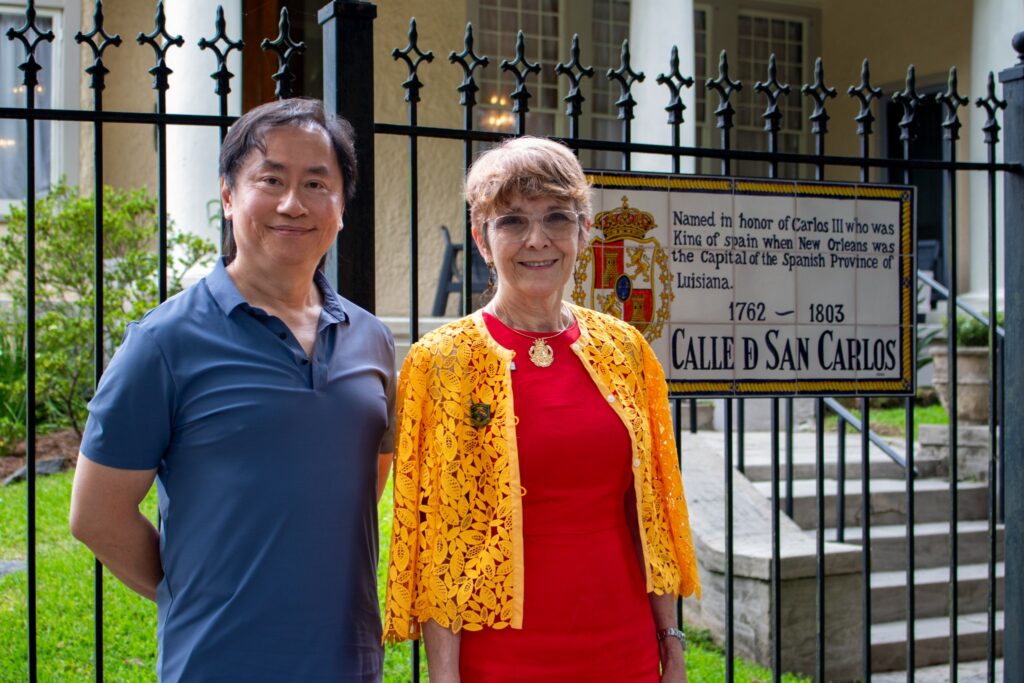
For Maria Isabel Page, Honorary Consul of Spain in Louisiana, the plaques are a way to let the city speak in more than one language at once.
“I feel like in New Orleans, we all can walk in the past,” Page said. “We have an incredible past.”
That past is often introduced to visitors through the phrase French Quarter. Page doesn’t dispute the French story. She wants room for the Spanish one, too.
From 1762 to 1803, Louisiana was governed by Spain. After the fires of 1788 and 1794, much of the Quarter was rebuilt under Spanish rule and Spanish building codes that favored brick and stucco over wood, helping shape the dense, courtyard-filled streetscape many people recognize as New Orleans before they know why.
The Spanish tile plaques make that history legible. They interrupt the familiar English and French names of the city with older names and a different way of seeing the same street.
“I remember from when I was young, seeing them in Spain and seeing the ones here in New Orleans,” Page said, “and I just feel like it ties us to the world.”
That sense of connection is the heart of the current project: a renewed effort to repair damaged Spanish ceramic street-name plaques in the French Quarter and to extend the tradition beyond the Vieux Carré, beginning on St. Charles Avenue.
Old names return
The original French Quarter plaques date to the late 1950s, when Spain gave New Orleans a set of ceramic street-name markers for the Vieux Carré. According to the City of New Orleans and the Vieux Carré Commission, the original 126 plaques were produced in Talavera de la Reina, Spain, in 1959 and installed throughout the French Quarter from 1959 to 1961 with guidance from the VCC.
They commemorated the street names used during the Spanish period of Louisiana, when New Orleans was the capital of the Spanish Province of Luisiana. A plaque on Toulouse Street identifies Calle de Tolosa. Markers at Jackson Square recall the Plaza de Armas. Other plaques preserve names tied to the city’s Spanish governors, religious institutions and colonial geography.
The plaques became part of the Quarter’s visual vocabulary: decorative enough to delight, scholarly enough to teach, and small enough that many locals passed them for years before noticing what they said.
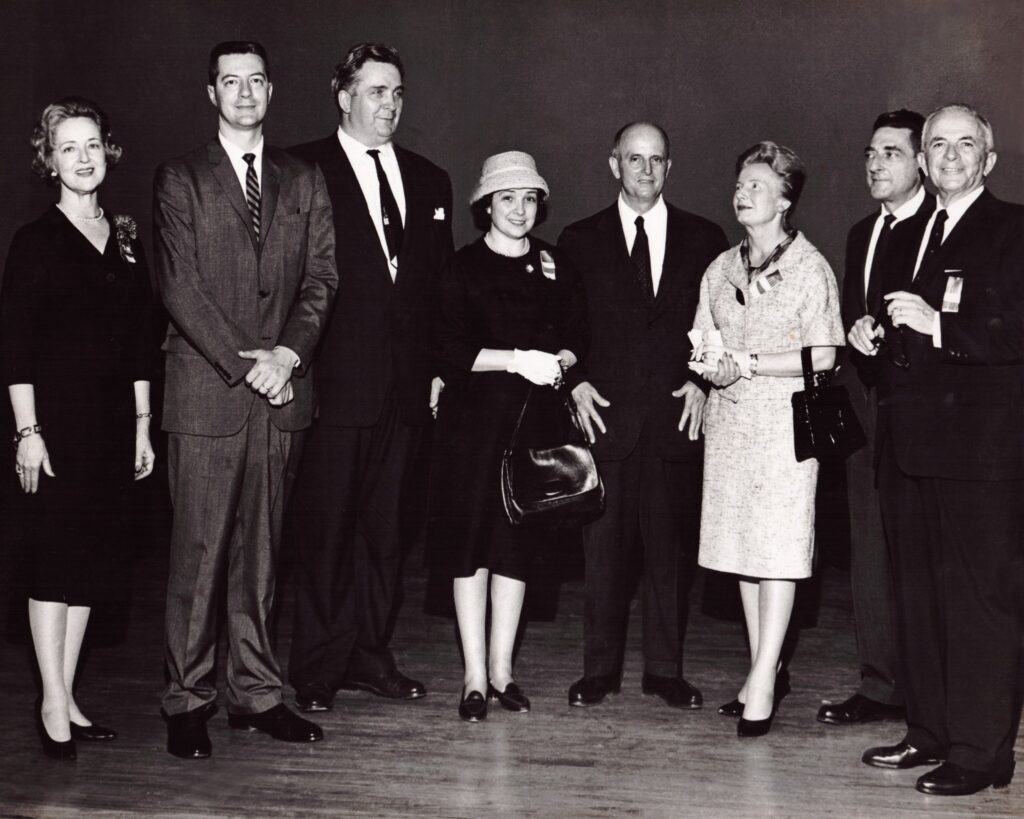
The late-1950s effort was supported by a network of Spanish and New Orleans advocates. Page identified Spanish citizen María García Daly, local businessman José Luis Baños I and Catherine “Cherie” Baños Schneider among the local supporters. José Luis Aparicio was Consul General of Spain in New Orleans at the time.
That context matters. The plaques weren’t simply objects shipped across an ocean. They were the result of relationships: consular, civic, personal and cultural. They also became proof that a city can tell a more complicated history through details embedded in everyday life.
Time has damaged many of those details. Weather, age, building repairs and exterior exposure have left some of the original plaques broken, faded or missing. In 2025, the City of New Orleans and the VCC opened an application process for French Quarter property owners with damaged existing plaques. The program was limited to replacement: no new French Quarter locations would be approved through that VCC process.
The current phase now includes 15 plaques: seven VCC-approved replacement plaques for French Quarter buildings, two plaques for Louisiana State Museum properties at the Cabildo and Presbytère, four Jackson Square gate plaques under the direction of the City’s Department of Parks and Parkways, and the two new St. Charles Avenue plaques that begin a related expansion beyond the Quarter.
The avenue asks its question
The St. Charles Avenue expansion began not with a committee vote, but with a question from Louis Kong.
Kong, a Louisiana-licensed architect and preservation advocate, heard Page speak about Spanish influence in New Orleans and the renewed plaque effort. As she described work in the Quarter, he began thinking about the rest of the city.
“What about St. Charles Avenue?” Kong recalled asking.
Later, he laughed at the way he had framed it during that first conversation.
“When I said, ‘What about me?’ the ‘me’ is not me, myself, the person,” Kong said. “The ‘me’ is St. Charles Avenue.”
For Kong, St. Charles wasn’t a decorative afterthought. It was the logical next place to carry the idea. He sees the avenue as a long historical line running from the edge of the old city through the American Sector, the Lower Garden District, the Garden District, Uptown, the university area and Carrollton. The streetcar line, the architecture, the oaks and the changing neighborhoods together trace the growth of New Orleans beyond the Quarter.
“St. Charles Avenue basically tied the whole city together,” Kong said.
The two new plaques use a Spanish rendering of the street’s name, Calle de San Carlos. Project research notes that the corridor was known as Nyades Street from the early 19th century until 1852, when it was renamed St. Charles Avenue. The research connects that name to St. Charles Borromeo, the patron saint of King Carlos III of Spain.
That makes the St. Charles plaques different from the replacement plaques in the Quarter. They aren’t substituting for a broken marker that once stood in the same spot. They borrow the visual language of the Quarter plaques and apply it to a street whose present name carries a Spanish connection.
One of the plaques was installed at 7111 St. Charles Ave., the longtime home of Page’s mother, María García Daly. The other was installed at 5726 St. Charles Ave., the Pink Lady, a historic St. Charles Avenue house. Both houses are associated with Kong’s own preservation work.
“My hobby is preserving St. Charles Avenue,” Kong said, “one building at a time.”
Not perfect. Better than perfect.
The plaques also tell a story of craft.
The new plaques were donated by ADEX, a Spanish ceramic tile manufacturer, with Spanish diplomatic representatives, the Spanish Consulate and local partners helping coordinate the project in New Orleans. Organizers describe the effort as a cultural gift from Spain to New Orleans, made possible through ADEX’s donated plaques and the work of people on both sides of the Atlantic.
Rafael Palop, CEO of ADEX USA, emphasized in correspondence that ADEX is donating the plaques, while Spanish officials and consular representatives have served as mediators and key supporters.
“Today, we are proud to give something back by helping preserve a small but cherished piece of New Orleans’ cultural heritage,” Palop said in a written statement.
ADEX traces its history to 1897 in Onda, Spain, one of the country’s historic centers of ceramics. More than 125 years later, the family-rooted company continues to combine traditional ceramic knowledge with modern production capacity. The company has worked on restoration projects including Park Güell in Barcelona.
For the New Orleans plaques, the latest clarification from ADEX and Stafford Tile is simple and important: the plaques are fully hand-painted using water-based paints, with no stencils. The process photos show pencil lines, brush marks, a hand moving across tile. They show work that cannot be mistaken for a printed sign.
“They’re perfect because they’re not perfect,” Page said. “That’s why they’re perfect.”
In a preservation context, that’s more than a charming line. It’s an argument. The slight irregularities of handwork are part of the evidence. They tell the viewer that someone made the thing, that the object required time, skill and judgment, and that the new plaque belongs to the same world of craft as the historic markers it honors.
The local side of the project required its own expertise. Peggy Stafford, founder of Stafford Tile & Stone, has helped connect the Spanish-made plaques with New Orleans property owners, approval processes and installers. Stafford Tile has been an ADEX dealer for more than 20 years and works with handmade and customizable tile and stone materials from artisans in the United States and abroad.
For this project, Stafford Tile received and quality-checked materials from ADEX and helped coordinate among ADEX, the Spanish Consulate, the Vieux Carré Commission, the City’s Department of Parks and Parkways and local installers.
“Cultural preservation is essential to paying tribute to the unique history of New Orleans,” Stafford said in a written response. “I am intrigued by the heritage of tile and stone as it crosses cultures with its own motifs and designs.”
Installation is not a matter of simply hanging tile on a wall. Stafford said George Mandella and Dan Keller have treated each plaque individually, assessing the needs of each location so the installation method supports longevity. The French Quarter plaques arrived in boxes of 18 pieces each and will be assembled and set at their respective sites. The Jackson Square gate plaques will require special attention because they must be mounted in a public setting with existing metalwork and oversight from Parks and Parkways.
Kong faced similar questions on St. Charles. The plaques arrived in pieces and had to be assembled on a backing suitable for outdoor exposure, then waterproofed, framed, bracketed and finished so they could hold up to New Orleans weather.
At 7111, a family story
At 7111 St. Charles Ave., the plaque is both public marker and private memory.
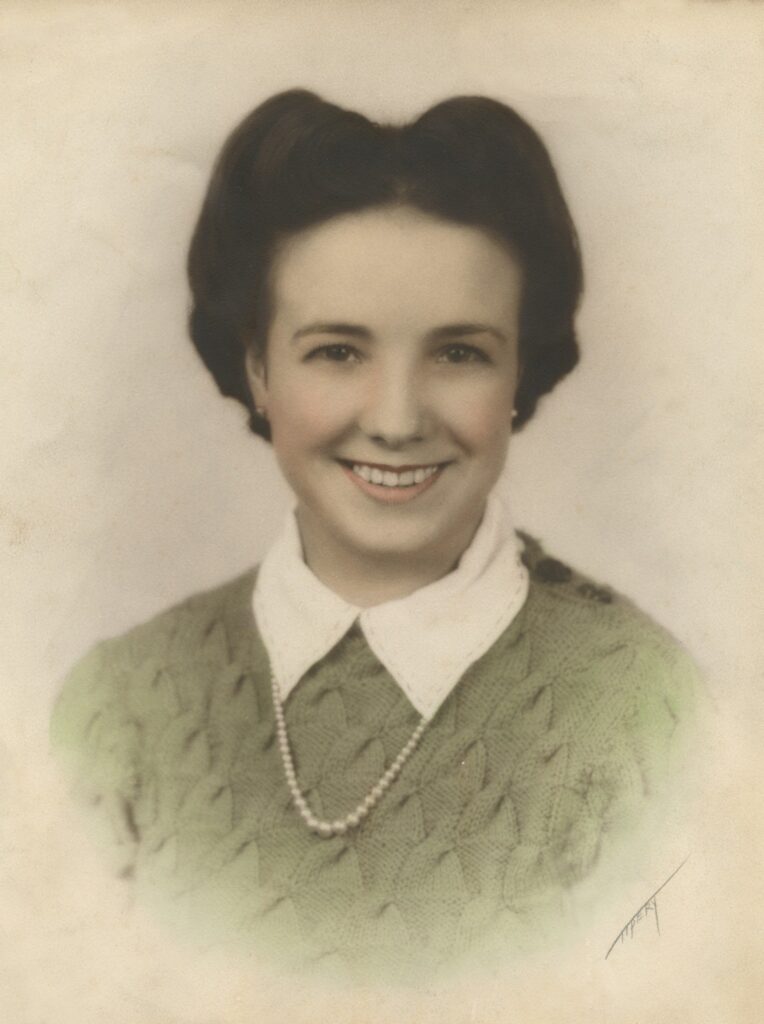
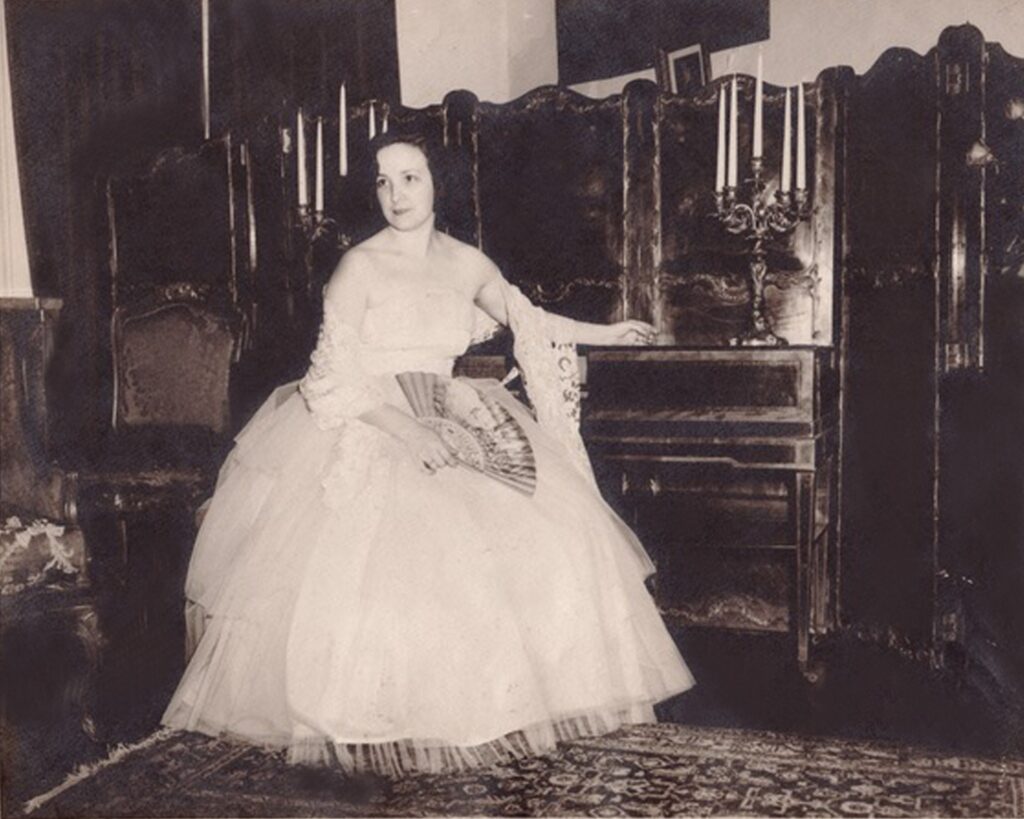
The house was the longtime home of Page’s mother, María García Daly, who was born in Mugardos, La Coruña, Spain, in 1925. According to her public obituary, Daly attended Newcomb College, worked at the Spanish Consulate in New Orleans in several capacities, received awards from the Spanish government for her service and became a founding member of La Sociedad Española.
Page is careful not to turn the original 1950s plaque program into a one-person story. The project involved consular officials, local supporters and Spanish citizens in New Orleans. But placing one of the first St. Charles Avenue plaques at her mother’s former home gives the new phase an emotional center.
“I think of her when I look at them,” Page said.
The most important thing readers should know about her mother, Page said, is simple: “how much she loved New Orleans. And how much she loved Spain.”
That love, Page said, was expressed through music, language, hospitality and the daily work of keeping cultural ties alive.
“That to me is the soul of New Orleans — the love of culture, music, you know, the opera house, just everything,” Page said.
At 7111, then, Calle de San Carlos is not only a translation of a street name. It’s a tribute to a woman whose life moved between Spain and Louisiana, and to a city whose identity has always been made from more than one inheritance.
What the tiles ask us to notice
The French Quarter replacement plaques are already in motion. The VCC-approved building plaques are intended for existing damaged or missing locations; the Louisiana State Museum plaques are planned for the Cabildo and Presbytère; and the four Plaza de Armas gate plaques for Jackson Square will require coordination with Parks and Parkways. Stafford Tile has said the plaques have arrived and individual installations are in process.
Organizers are discussing a future event for participating property owners, though no date has been announced. Page has imagined it as a public recognition of the gift, with Spanish food, music and acknowledgment of a project she believes New Orleans should welcome if the city wants such relationships to continue.
Longer term, Page hopes other property owners on Spanish-named or Spanish-linked streets will be inspired to participate. The St. Charles plaques offer a first model outside the Quarter: a historic building, a willing owner, a Spanish-made ceramic plaque and a story that reaches beyond one address.
The timing also matters. As America250 commemorations turn attention toward the country’s founding era, Page sees an opening to reconsider Spain’s role in the Gulf South and the American Revolution. But the plaques don’t require a lecture to do their work. They ask only that someone pause on a sidewalk and read.
That may be why the tradition has lasted. These plaques leave history where people can live with it: on the wall of a house, at the corner of a street, beside a daily walk.
“I want people to know the relationship between the city and Spain,” Kong said.
On St. Charles Avenue, that relationship now has a surface, a color, a line of lettering and a name. Calle de San Carlos. A small plaque. A larger city than the one many people thought they knew.
Current plaque locations in this phase
- 1350 Bourbon St. – Calle de Borbon
- 716-726 Governor Nicholls St. – Calle del Hospital
- 911 Burgundy St. – Calle del Maine
- 1113 Chartres St. – Calle del Arsenal y de las Ursulinas
- 1140 Royal St. – Calle del Hospital
- 403 Royal St. – Calle Real
- 403 Royal St., Conti Street side – Calle de Conti
- Presbytère/St. Ann Street side – Calle de Santa Ana
- Cabildo/St. Peter Street side – Calle de San Pedro
- Four Jackson Square entrances – Plaza de Armas
- 7111 St. Charles Ave. – Calle de San Carlos
- 5726 St. Charles Ave. – Calle de San Carlos